Promo code APP3 – £3 discount on your first order in app
  Free delivery for orders over £49


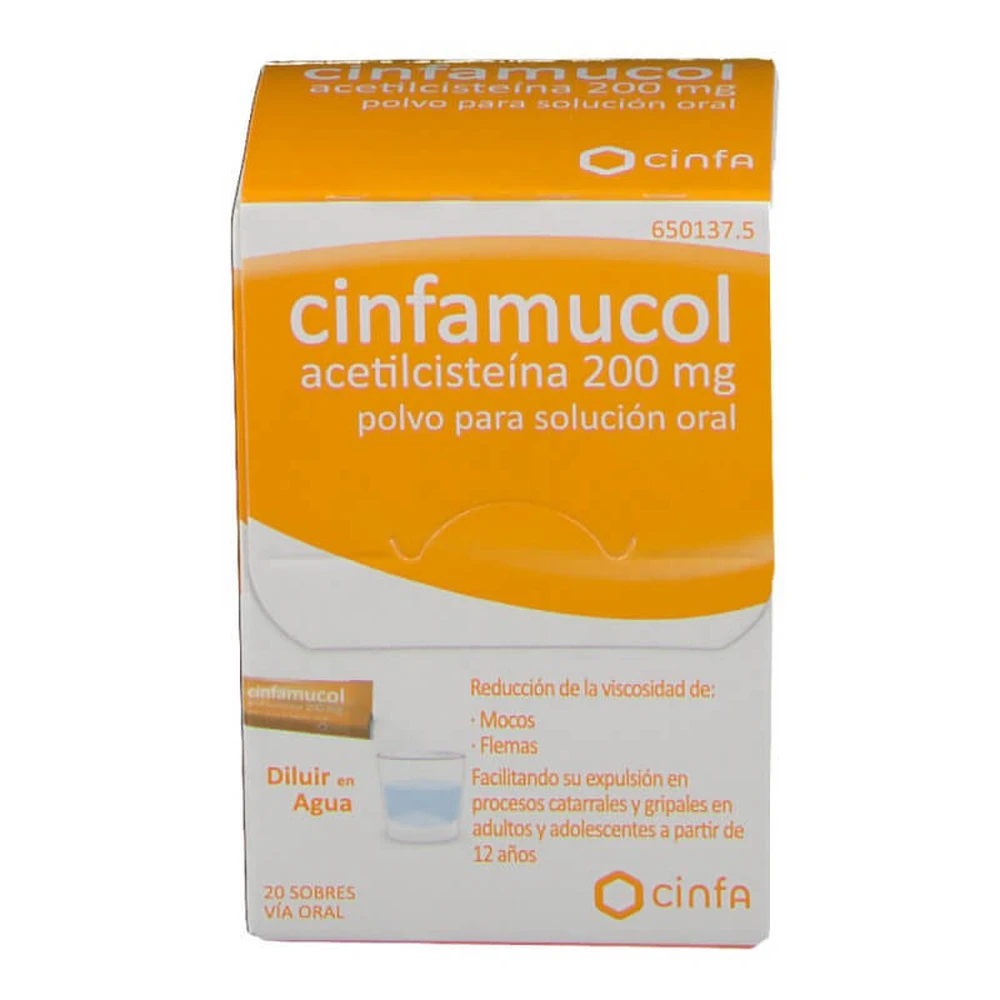
CINFAMUCOL ACETYLCYSTEINE 200 MG 20 SACHETS
Description
ACTION AND MECHANISM
- [MUCOLYTIC]. It is the N-acetylated derivative of the natural amino acid cysteine. It reduces the viscosity of bronchial secretions, facilitating their elimination, probably due to the presence of a free thiol group. This group is able to break the disulfide bonds that maintain the three-dimensional structure of mucoproteins, resulting in the thinning of the secretion. Its effects are pH-dependent, being maximal at a pH between 7 and 9.
SENIORS
No specific problems have been described in this age group. However, hepatic or respiratory insufficiency is more common in these patients, so acetylcysteine should be used with caution.
PATIENT ADVICE
- It is recommended to drink plenty of water during treatment.
- The preparation may have a slight sulfurous odor, characteristic of the active ingredient and not of an alteration of the preparation.
- You should notify your doctor if you experience widespread itching all over your body.
- If after five days the symptoms continue or worsen, it is advisable to see a doctor.
CONTRAINDICATIONS
- Hypersensitivity to acetylcysteine or any other component of the medication.
EFFECTS ON DRIVING
Acetylcysteine does not usually cause drowsiness, but some cases have been reported in rare instances. Caution is advised when driving until there is reasonable certainty that the treatment does not negatively affect the patient's ability to drive.
PREGNANCY
FDA Pregnancy Category B. Administration of 500 mg/kg/24 hours orally, or nebulization of acetylcysteine and isoproterenol for 30–35 minutes in pregnant rabbits, showed no evidence of teratogenicity. Peri- and postnatal studies also failed to detect any evidence of fetal or neonatal harm. Acetylcysteine appears to cross the placental barrier. Adequate and well-controlled studies in humans have not been conducted; therefore, this drug should only be used when safer therapeutic alternatives are unavailable.
PHARMACOKINETICS
Oral, parenteral route:
- Absorption: After oral administration of a 200-600 mg dose, it is rapidly absorbed, reaching a Cmax of 0.35-4 mcg/ml within 0.5-1 hours. Its bioavailability is very low (4-10%), probably due to extensive intestinal and first-pass hepatic metabolism.
- Distribution: It circulates in the plasma both freely and bound to proteins (50%) via labile disulfide bridges or covalent peptide bonds. It exhibits extensive diffusion throughout extracellular fluids, primarily localizing in bronchial secretions. Its Vd is 0.33-0.47 L/kg.
- Metabolism: It undergoes intense intestinal and hepatic metabolism, resulting in sulfur derivatives such as cysteine, N-acetylcystine, N,N-acetylcystine or glutathione.
- Elimination: Acetylcysteine is eliminated by metabolism (70%) and subsequent excretion in urine, in free form (30%) or as metabolites. Its elimination half-life is 6.25 hours (oral) or 5.58 hours (intravenous).
Pharmacokinetics in special situations:
- Children: Following intravenous administration, elimination half-life values of 11 hours have been found.
- Liver failure: The elimination half-life is increased by 80% in patients with severe liver failure or with primary or secondary biliary cirrhosis.
INDICATIONS
- [BRONCHIAL HYPERVISCOSITY].
INTERACTIONS
- Antibiotics. Acetylcysteine may be incompatible with amphotericin B, sodium ampicillin, cephalosporins, erythromycin lactobionate, or some tetracyclines. It is recommended to separate doses by at least two hours.
- Antitussives. Acetylcysteine increases the fluidity of bronchial secretions, so it is not advisable to administer it together with antitussives, which could inhibit the cough reflex and lead to pulmonary obstruction.
- Drugs that inhibit bronchial secretion (anticholinergics, tricyclic antidepressants, H1 antihistamines, antiparkinsonian drugs, MAOIs, neuroleptics). These may antagonize the effects of acetylcysteine.
- Nitroglycerin. Acetylcysteine could potentiate the vasodilatory effects of nitroglycerin and its adverse reactions at very high doses (100 mg/kg).
- Metal salts. Acetylcysteine may have chelating effects on some metals such as gold, calcium, or iron, thus decreasing their absorption. It is recommended to separate the intake of mineral supplements and acetylcysteine by at least two hours.
LACTATION
It is unknown whether acetylcysteine is excreted in breast milk, and if so, whether this could affect the infant. It is recommended to discontinue breastfeeding or avoid administering this medication.
CHILDREN
No specific problems have been described in this age group. Use is acceptable.
GUIDELINES FOR PROPER ADMINISTRATION
Dissolve the contents of the sachet in a glass of water, then drink it.
POSOLOGY
- Adults, oral: 200 mg/8 h or 600 mg/24 h in a single dose, preferably in the mornings.
- Children and adolescents under 18 years of age, oral:
* Adolescents aged 12 years and over: 200 mg/8 h.
* Children < 12 years: safety and efficacy have not been evaluated.
It is recommended to take acetylcysteine with food.
Missed dose: Take as soon as possible if only a short time has passed. Otherwise, skip the missed dose. Do not double the dose at the next administration.
Duration of treatment: If symptoms do not improve or worsen after 5 days of treatment, or if accompanied by fever, skin rashes, headache or persistent sore throat, consult your doctor and/or pharmacist.
PRECAUTIONS
- Severe hepatic insufficiency, hepatic cirrhosis. In these patients, clearance may be decreased, with a consequent increased risk of adverse reactions. Therefore, close monitoring of the patient is recommended due to the risk of anaphylactic reactions. - Peptic ulcer. Acetylcysteine can sometimes cause nausea and vomiting, especially at high doses, thus increasing the risk of gastric bleeding. Furthermore, it has also been postulated that acetylcysteine increases the fluidity of gastric mucus, leading to a decrease in its protective action. Extreme caution is recommended in patients with peptic ulcers. - Asthma. In asthmatic patients, those with severe respiratory insufficiency, or those with diseases that present with bronchospasm, an increase in the fluidity of secretions can lead to airway obstruction if expectoration is inadequate. Therefore, extreme caution is advised. - Increased expectoration. At the start of treatment, an increase in expectoration may occur due to the increased fluidity of secretions. This effect diminishes after several days of treatment. If symptoms persist or worsen after five days of treatment, it is advisable to reassess the clinical situation.
PRECAUTIONS RELATING TO EXCIPIENTS
This medicine contains sunset yellow FCF as an excipient. It may cause allergic-type reactions, including asthma, especially in patients with salicylate allergy.
ADVERSE REACTIONS
Adverse reactions to acetylcysteine are rare, mild, and transient. The most frequent adverse reactions are:
- Digestive. Occasionally, nausea, vomiting, diarrhea, and gastric hyperacidity may occur, especially when used at high doses.
- Hepatic. Some cases of [INCREASE TRANSAMINASES] have been described after the administration of large doses of acetylcysteine, which reversed after a few days of discontinuing treatment.
- Neurological/psychological. Some cases of [HEADACHE], [DROWSY] have been described.
- Respiratory. These are usually exclusive to administration by inhalation. May include [Rhinorrhea], [Bronchitis], [Tracheitis], [Hemoptysis] and [Bronchial Spasm].
- Eyeglasses. [BLURRED VISION].
- Disorders of the ear and labyrinth: [TINNITUS].
- Allergic/dermatological. Within 30-60 minutes of administration, hypersensitivity reactions may occur, presenting with generalized urticaria, moderate fever, exanthematous eruptions, pruritus, angioedema, dyspnea, and hypotension. These reactions are more frequent and severe with parenteral administration, and can be fatal, whereas they are rare with oral or inhalation administration.
In case of allergic reactions, it is recommended to temporarily discontinue treatment and administer H1 antihistamines, and if necessary, adrenaline. If the allergic reaction recurs, treatment should be discontinued and not restarted.
- General. [HYPERHIDROSIS].
ADVERSE REACTIONS RELATED TO EXCIPIENTS
- Because it contains sunset yellow (E-110) it may cause [HYPERSENSITIVITY REACTIONS].
OVERDOSE
Symptoms: Acetylcysteine has been administered to humans at doses up to 500 mg/kg/24 hours without causing side effects, so the possibility of poisoning due to overdose of this active ingredient can be ruled out. However, in case of massive ingestion, an intensification of adverse effects, primarily gastrointestinal, is expected. Treatment: Symptomatic treatment will be used. The airways will be kept clear of secretions by positioning the patient on their side and performing bronchial aspiration. If deemed necessary, and no more than 30 minutes have elapsed since ingestion, gastric lavage will be performed.
Features
| Product code | 585327 |
| Category | Respiratory System Teas, Teas for diseases |
| Quantity | 20 |
| Dose | 200 mg |
| Product type | Sachets |
| Delivery from | Spain |
CINFAMUCOL ACETYLCYSTEINE 200 MG 20 SACHETS
CINFAMUCOL ACETYLCYSTEINE 200 MG 20 SACHETS
Delivery from Spain

 9 - 19 Oct

 Guaranteed delivery from Spain: 9 - 19 October
-
£8.50Delivery: £5.99 (free from £49)
Delivery from Spain:
9 - 19 October
-
 Pay securely with your preferred payment method








Recently viewed products






Reviews

CINFAMUCOL ACETYLCYSTEINE 200 MG 20 SACHETS
 Earn £1 Reward for every review
- For each submitted and approved review you can earn £1 Reward on your Rewards Credit.
- Rewards are given once for each purchased product you have reviewed.
- You have to be authorised to receive Rewards
All reviews

There are no reviews for this product.









 Description