Promo code APP3 – £3 discount on your first order in app
  Free delivery for orders over £49


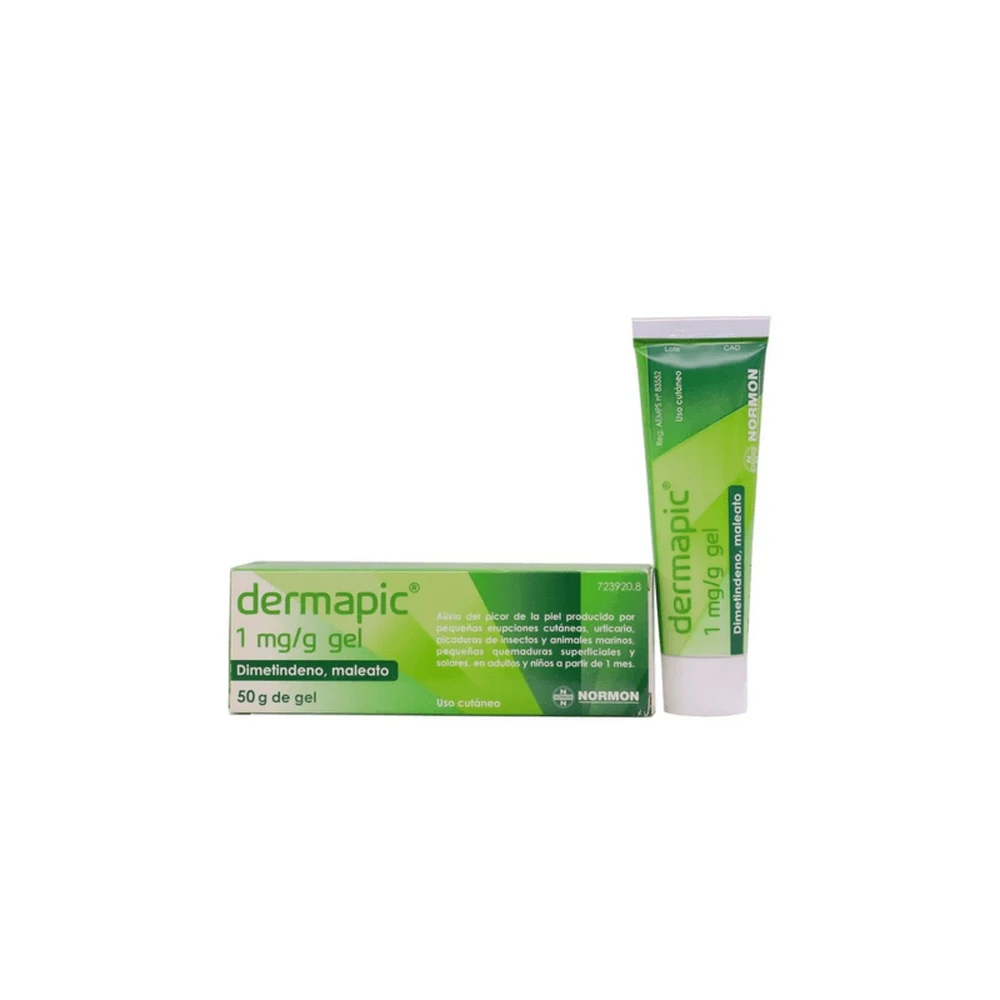
dermapic-1-mgg-gel-cutaneo-1-tubo-50-g
Description
ACTION AND MECHANISM
- Anti-allergic. Dimetindene, a phenindene derivative, is a competitive antagonist of histamine H1 receptors. It has a high affinity for these receptors. It significantly reduces capillary hyperpermeability associated with immediate hypersensitivity reactions. It is effective against pruritus of various etiologies and rapidly relieves itching and irritation. The emulsion formulation also has cooling, soothing, and emollient properties.
PATIENT ADVICE
- Avoid prolonged sun exposure of treated skin areas.
- Avoid contact with eyes, mouth, ear or other mucous membranes.
- If symptoms worsen or persist for more than 7 days, discontinue treatment and consult a doctor.
CONTRAINDICATIONS
- Hypersensitivity to any component of the medication. Cross-reactions with other antihistamines may occur, therefore the use of any H1 antihistamine is not recommended in patients who have experienced hypersensitivity to any compound in this group.
PREGNANCY
Animal safety: Studies conducted in animals with dimetindene maleate show no teratogenic potential or direct or indirect harmful effects on pregnancy, embryonal/fetal development, parturition or postnatal development.
Safety in humans: It is unknown whether dimetindene can be absorbed topically. Adequate and well-controlled studies in humans have not been conducted; therefore, the use of this drug is only acceptable if the potential benefits outweigh the possible risks and when no safer therapeutic alternatives exist.
During pregnancy, it should not be applied to large areas of skin, especially if the skin is inflamed or damaged.
Effects on fertility: Animal studies have not demonstrated toxicity. No specific studies have been conducted in humans.
PHARMACOKINETICS
- It penetrates the skin rapidly and exerts its antihistamine effect within minutes. After topical application in healthy volunteers, the systemic availability of dimetindene is less than 10% of the applied dose.
INDICATIONS
- Relief of [PRURITUS] associated with [DERMATOSIS], [URTICARIA], [INSECT BITES] and marine animal bites, minor [SUNBURN] and minor superficial [BURNS].
INTERACTIONS
- It could enhance the photosensitizing effects of other active ingredients that cause photosensitivity reactions.
LACTATION
Animal safety: no data available.
Safety in humans: It is unknown whether it is excreted in breast milk, and the potential consequences for the infant. Its administration during breastfeeding is not recommended.
During breastfeeding, it should not be applied to large areas of skin, especially if the skin is inflamed or damaged.
GUIDELINES FOR PROPER ADMINISTRATION
Apply a thin layer to the affected area (unbroken skin) and massage gently. Do not cover with occlusive dressings. Do not apply to large areas of skin.
POSOLOGY
- Adults and children > 2 years: Apply a thin layer 2-4 times a day.
- Children > 1 month to 2 years: under medical supervision.
PRECAUTIONS
- Avoid applying it to eroded, bleeding, blistered, or exudated skin, as percutaneous absorption could occur, resulting in systemic effects.
- Dimetindene may cause [PHOTOSENSITIVITY REACTIONS], so it is recommended to avoid sun exposure during treatment and to protect yourself with sunscreens.
- [PORPHYRIA]. H1 antihistamines have been associated with the onset of porphyric attacks, so they are not considered safe in these patients.
PRECAUTIONS RELATING TO EXCIPIENTS
- Because it contains benzalkonium chloride, it may be irritating and cause skin reactions.
ADVERSE REACTIONS
The side effects of dimetindene are usually mild and transient, and are more frequent during the first few days of treatment. There is significant interindividual variability in the frequency and intensity of symptoms, affecting mainly young children and the elderly.
The most common adverse reactions are:
- Allergic/dermatological. Rarely, dryness, rash, stinging, or itching of the skin may occur. Hypersensitivity reactions may rarely occur after topical administration. Photosensitivity reactions may also occur after intense exposure to sunlight, with contact dermatitis, pruritus, rashes, and erythema.
ADVERSE REACTIONS RELATED TO EXCIPIENTS
- This medicine contains propylene glycol, so it may cause [SKIN IRRITATION].
OVERDOSE
Symptoms: Accidental ingestion of a significant amount may lead to some of the symptoms of H1 antihistamine overdose, which are: CNS depression with drowsiness (mainly in adults), CNS stimulation and antimuscarinic effects (especially in children), including excitability, ataxia, hallucinations, tonic-clonic spasms, mydriasis, dry mouth, facial flushing, urinary retention, and fever. Hypotension and cardiorespiratory collapse may also occur.
- Treatment: There is no specific antidote for antihistamine overdose; usual emergency resuscitation should be performed, including activated charcoal, saline laxatives, and cardiopulmonary support measures when necessary. Stimulants should not be administered. Vasopressors may be used to treat hypotension.
Features
| Product code | 585337 |
| Category | Skincare and beauty, Dermatology, Useful kits, Products from Across Europe, Products from Spain |
| Quantity | 1 |
| Volume | 50 g |
| Product type | Gel |
| Delivery from | Spain |
dermapic-1-mgg-gel-cutaneo-1-tubo-50-g
dermapic-1-mgg-gel-cutaneo-1-tubo-50-g
Delivery from Spain

 6 - 15 Sep

 Guaranteed delivery from Spain: 6 - 15 September
-
£13.60Delivery: £5.99 (free from £49)
Delivery from Spain:
6 - 15 September
-
 Pay securely with your preferred payment method










Reviews

dermapic-1-mgg-gel-cutaneo-1-tubo-50-g
 Earn £1 Reward for every review
- For each submitted and approved review you can earn £1 Reward on your Rewards Credit.
- Rewards are given once for each purchased product you have reviewed.
- You have to be authorised to receive Rewards
All reviews

There are no reviews for this product.








 Description