Promo code APP3 – £3 discount on your first order in app
 Free delivery for orders over £49


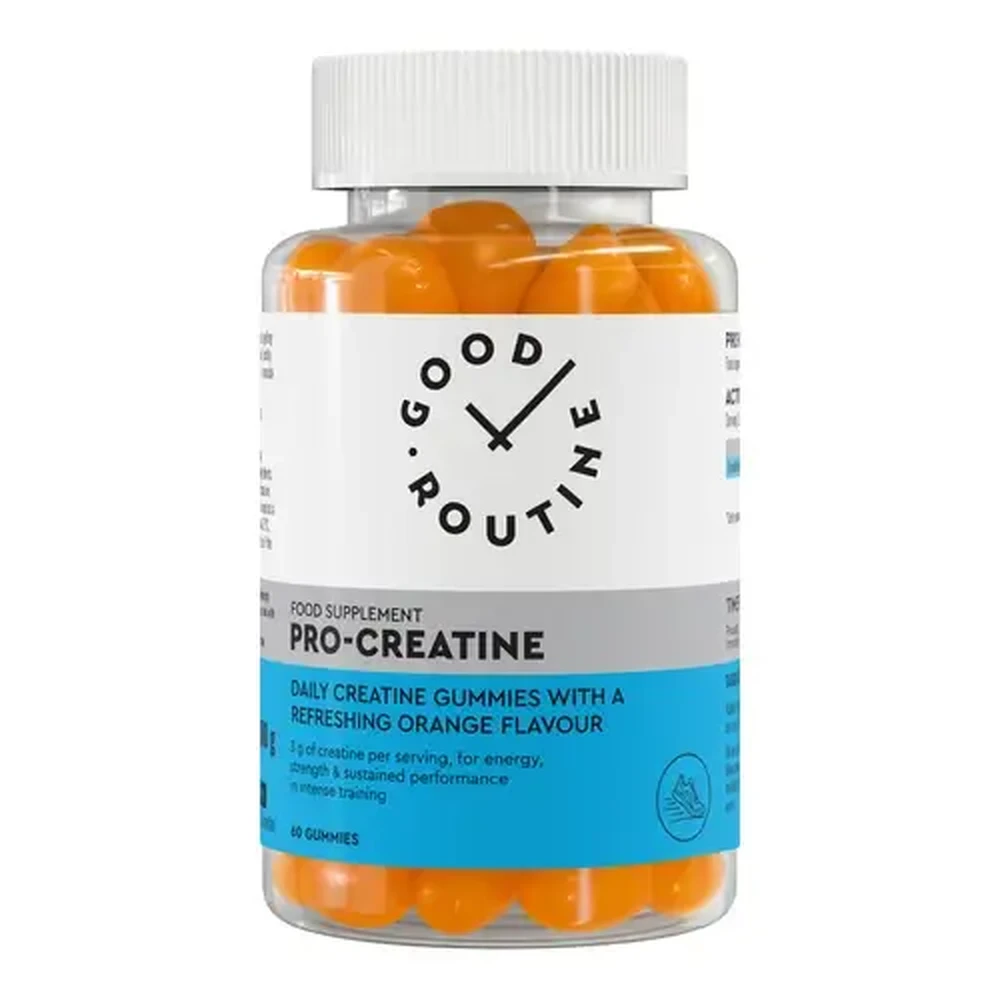
Pro-Creatine 60 Gummies Secom Good Routine
Description
Creatine is a naturally occurring compound in the body, stored predominantly in skeletal muscle and, to a lesser extent, in cardiac muscle and brain, and plays a role in cellular energy metabolism. Creatine increases physical performance in successive bursts of short-term, high-intensity exercise. Pro-Creatine provides 3 g of creatine per serving, in the form of 2 pleasant orange-flavored jelly beans. The formula offers a practical and convenient way to integrate creatine into your daily routine. *The beneficial effect is obtained with a daily consumption of 3 g of creatine, according to Regulation (EU) 432/2012.
Advantages of Pro-Creatine 60 jellybeans
º The formula offers a practical and convenient way to integrate creatine into your daily routine
º Easy administration, in a ready-to-use format
º Precise dosing: preset amount for each administration, for simple and consistent use.
º Jelly format allows full dose administration, without sediment or undissolved particles
º Can be administered daily, long-term, to increase and maintain muscle creatine and phosphocreatine reserves, thanks to its comfortable administration
º Suitable for vegetarian and vegan diets
º No added sugar, with sweeteners from natural sources
º Pleasant orange taste
º Does not contain GMOs, gluten, crustaceans, fish and derivatives, eggs, peanuts/nuts and derivatives, soy, milk and derivatives (including lactose)
Method of administration
Adults: chew 2 jellies/day or as recommended by your specialist consultant.
Effects and benefits
Creatine
º is synthesized naturally in the body from the amino acids arginine, glycine and methionine, with an important role in cellular energy metabolism
º it is not a source of energy through oxidation (burning), like glucose or fatty acids, but participates in the rapid regeneration of ATP (adenosine triphosphate), in organs with intense metabolic consumption: skeletal muscles (95% of reserves), brain, myocardium, retina and testicles
º the body covers its daily requirement of 2–4 g from two sources:
- own synthesis (approximately 1 g, in the kidneys, pancreas and liver): two enzymes transform arginine, glycine and methionine into creatine
- food, especially meat and fish
Once in the body, creatine is taken up into cells through a specific transporter, where it participates in the restoration of ATP through the shuttle of phosphocreatine.
Phosphocreatine shuttle and energy transport
Cells cannot store ATP in large quantities—muscles have reserves for about 2 seconds of maximum effort, and the brain consumes energy continuously. During exercise, ATP loses one of its three phosphate groups and becomes ADP, the consumed form.
ATP is produced in mitochondria from glucose and fatty acids. However, it is a large molecule that moves slowly through the cell, and during intense exercise the energy demand exceeds the speed at which the mitochondria can regenerate it.
This is where creatine comes in, its job is to transport phosphate groups. The enzyme creatine kinase transfers a phosphate group to creatine and converts it into phosphocreatine — a small molecule that quickly travels from the mitochondria to sites of consumption, such as muscle fibers and synapses (connections between nerve cells). There, the phosphate group is given up to ADP in fractions of a second, and ATP is regenerated. The free creatine returns to the mitochondria, receives a new phosphate group, and the cycle begins again.
Phosphocreatine shuttle supports intense physical effort in the first 10–15 seconds, and in nerve cells it supports the continuous restoration of consumed ATP.
Creatine intake increases muscle content by 20–40% from baseline, up to the saturation threshold, with a larger reserve available for phosphocreatine shuttle.
Saturation of creatine reserves can be done by:
º continuous administration (comfortable and suitable for long-term use): 3–5 g/day, for 3–4 weeks; increases muscle creatine content up to the saturation threshold of the muscle
º loading phase (traditional): 20 g/day, in 4 doses of 5 g each, for 5–7 days; it speeds up reaching the same saturation plateau, but is more difficult to tolerate digestively
Creatine metabolism
Approximately 1–2% of the total creatine reserve is transformed daily, irreversibly, into creatinine (a biologically inactive compound, eliminated by the kidneys), hence the daily replacement requirement.
The amount of creatinine eliminated daily is proportional to the size of the creatine reserve in the body.
Supplementation helps cover creatine needs in people with lower natural reserves.
Creatine reserves in the body vary depending on muscle mass, diet and life stages:
º women — have lower total muscle mass, and creatine metabolism is influenced by hormonal variations
º vegetarians and vegans — meat and fish are the main dietary sources of creatine, and in their absence the intake is significantly reduced
º the elderly — muscle reserves decrease with age, through the reduction of type II muscle fibers, through limited participation in intense activities and through decreased food intake
Suitable for:
º Sports performance and active lifestyle:
- Strength training and intense effort such as: CrossFit, functional or high-intensity interval training (HIIT), where rapid ATP recharge supports explosive strength.
- Sports with short, intense and repeated efforts: recommended for sprints, short-distance swimming, tennis, cycling, martial arts or team sports.
- Activities with mixed demands (physical + cognitive) such as: car/motorcycle driving, racket sports and competitions that require coordination, muscle control, quick reactions and sustained mental effort.
- Dynamic lifestyle: supports daily energy, from a busy work schedule and recreational activities to regular workouts.
º Maintaining longevity routines, active aging and neurolongevity
- Intense cognitive demand: periods of learning, prolonged work, insufficient sleep or sustained mental effort.
- Active routines after 40: directly oriented towards maintaining strength, tone and skeletal muscle mass.
- Peri- and postmenopausal periods
º Special diets and administration preferences
- Vegetarian, vegan or flexitarian diet
Contributes to:
Increased physical performance during intense exercise
During short, intense efforts, the muscle needs energy faster than the mitochondria can produce it. This is where the phosphocreatine shuttle comes in: it quickly replenishes ATP, without oxygen consumption and without the direct use of glucose (glycolysis).
Creatine intake supports the increase in muscle phosphocreatine reserves, which plays a role in supporting repetitive high-intensity efforts; the additional volume of effort thus supports the nervous system's ability to activate and coordinate multiple muscle fibers simultaneously
the phosphocreatine shuttle supports the rapid regeneration of ATP, necessary for both contraction and the return of calcium to the stores inside the fiber; the relaxation and ability of the fiber to contract again depends on this process (creatine monohydrate)
maintains contraction force during intense effort, by limiting muscle fiber acidification —one of the causes of decreased strength and fatigue (creatine monohydrate)
Creatine intake, studied in the context of muscle development, maintenance and recovery
Muscle mass is maintained by a balance between the formation and degradation of muscle proteins. Creatine participates in the building processes and limits the breakdown, in combination with resistance training.
Creatine captured in muscle cells attracts water inside them, and the increase in cell volume is perceived by the cell as a signal to restore muscle proteins (creatine monohydrate)
the muscle cell has a mechanism that evaluates the availability of nutrients and energy; when these are sufficient, the mechanism helps to preserve and form muscle proteins and limits their breakdown (proteolysis) (creatine monohydrate)
During periods of reduced physical activity, the muscle gradually loses mass and strength; upon resumption of movement, the creatine reserves in the muscles support the intensity and volume of exercise, on which muscle recovery depends (creatine monohydrate)
Creatine intake associated with a dietary carbohydrate source, studied in the context of muscle glycogen restoration after exercise
Glycogen is the form in which the body stores glucose in the muscles and the main reserve used in long-term effort, progressively consumed during it. After effort, the muscle restores these deposits from glucose from food. Creatine participates in this process by supporting specific transporters that take glucose from the blood and introduce it into the muscle fiber.
Creatine intake, studied in the context of maintaining mobility and good physical functioning in the elderly
With age, muscle creatine reserves decrease through:
- decrease in type II muscle fibers (involved in strength and fast reactions)
- limited participation in intense activities
- decreasing dietary intake of creatine, which comes from meat and fish.
Daily creatine consumption may increase the effect of resistance training on muscle strength in adults over 55 years of age – associated with regular resistance training (creatine monohydrate)
participates in maintaining muscle mass, mobility and functional capacity, by limiting the breakdown of muscle proteins (creatine monohydrate)
participates in restoring muscle mass and strength after periods of reduced physical activity, once movement is resumed, by restoring muscle reserves of creatine and phosphocreatine (creatine monohydrate)
Creatine intake, studied in the context of cerebral energy metabolism
The brain is, after skeletal muscle, the tissue with the highest consumption of creatine. Nerve cells cannot store ATP in large quantities and depend on its continuous replenishment through phosphocreatine. The prefrontal cortex — the area involved in executive functions, attention, working memory and decision-making — is among the regions with the highest energy consumption.
participates in nerve cells in the same energy support processes as in muscles (creatine monohydrate)
Creatine intake, studied in the context of recovery after periods of reduced physical activity or inactivity
Creatine intake, studied in the context of muscle mass and strength in women
Women have a lower rate of creatine synthesis than men and a lower dietary intake, and creatine metabolism is influenced by estrogen — the hormone that regulates the activity of the enzyme creatine kinase and supports mitochondrial function. Creatine availability thus changes with hormonal variations during the menstrual cycle, perimenopause, and menopause.
Composition (Per 2 jellies)
- Creatine (from creatine monohydrate) 3000 mg
Directions for use: Adults: chew 2 jellies/day or as recommended by your specialist consultant.
Careful
Store below 25°C. As the product includes ingredients from natural sources, it is not standardized in terms of organoleptic properties. Thus, there may be variations in color, odor or appearance from one batch to another, without affecting the efficacy or safety of the product.
Each batch of raw materials and finished product undergoes a rigorous verification process to ensure appropriate efficacy, bioavailability and safety.
Contraindications
Use by persons under 18 years of age, pregnant women, women who wish to become pregnant or who are breastfeeding, people with allergies to any of the ingredients or who are using allopathic medication can only be done upon the recommendation of a specialist consultant.
Features
| Product code | 911257 |
| Category | Creatine, Sports nutrition |
| Brand | Solaray |
| Range | Good Routine |
| Quantity | 60 |
| Product type | Jellies |
| Delivery from | Romania |
Pro-Creatine 60 Gummies Secom Good Routine
Pro-Creatine 60 Gummies Secom Good Routine
Delivery from Romania

 19 - 21 Nov

 Guaranteed delivery from Romania: 19 - 21 November
-
£33.50Delivery: £5.99 (free from £49)
Delivery from Romania:
19 - 21 November
-
 Pay securely with your preferred payment method





 100% authenticOur products are sourced directly from authorized distributors and licensed pharmacies.
Don't overpay for your favourite productsThe same product can cost less in another country. We compare sellers across Europe for you.
 Shop at the best prices across Europe
Most marketplaces only work with sellers from their own country. We go further: we bring together trusted sellers from different European markets in one place. The same product can cost noticeably less in a neighboring country, and now you can take advantage of that.
When a product is sold in several countries, you see all the options side by side: price, country and delivery time.
- You decide what matters most. Want to save? Pick the lowest price. Need it sooner? Pick the closest seller.
- Products you can't find nearby. Many items are only sold in certain countries. We make them available to you.
- We handle the delivery. You order as usual, and we take care of international shipping to your door.
If you live in Germany near the Czech border, it's common to cross it for cheaper fuel. We work the same way, except you don't have to go anywhere.















Top Rated


















Reviews

Pro-Creatine 60 Gummies Secom Good Routine
 Earn £1 Reward for every review
- For each submitted and approved review you can earn £1 Reward on your Rewards Credit.
- Rewards are given once for each purchased product you have reviewed.
- You have to be authorised to receive Rewards
All reviews

There are no reviews for this product.















 Description