Código promocional APP3 - £3 de descuento en su primer pedido en la app
  Envío gratuito para pedidos superiores a £49


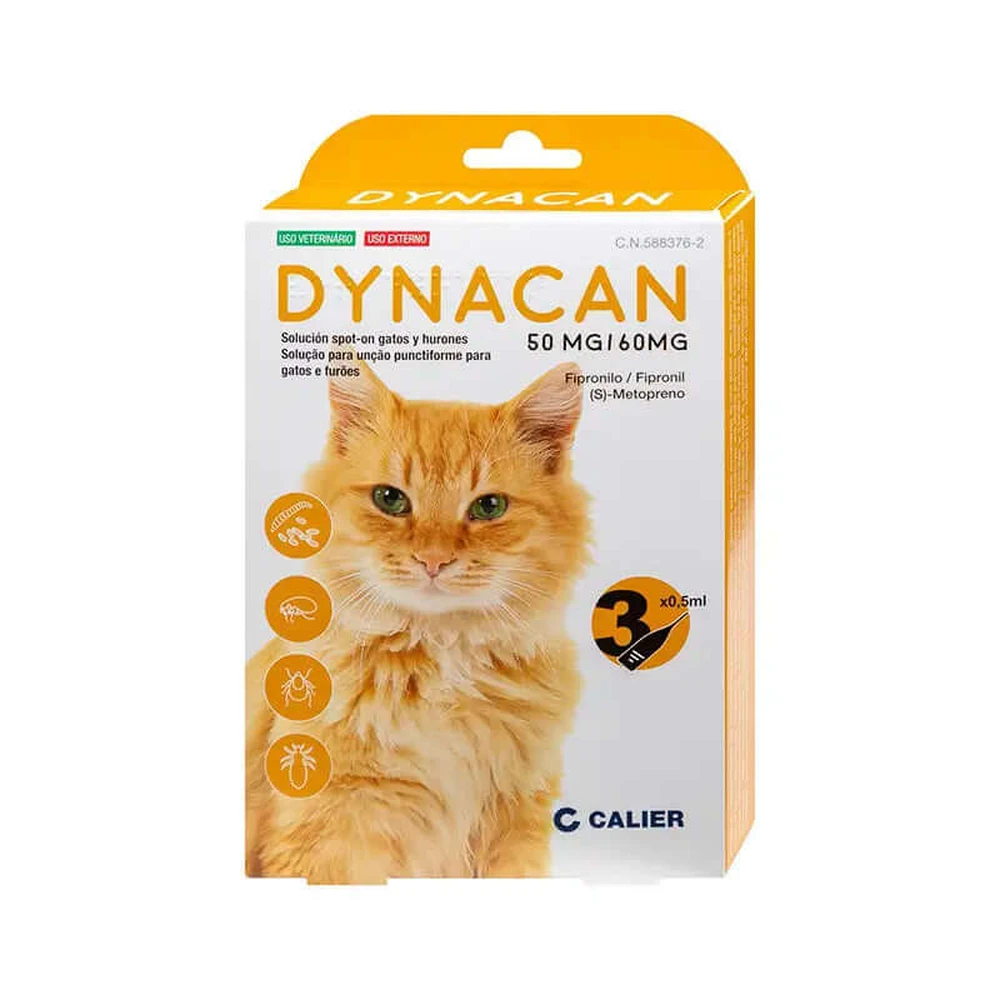
Calier Dynacan Gato 3Pip
Descripción
Dynacan Spot On Gatos 3 Pip es un Antiparasitario Externo, recomendado para gato
Composición e Ingredientes
Cada pipeta de 0,5 ml contiene:
Sustancias activas:
Fipronilo.…………………………………………………………………….50,00 mg
(S)-metopreno..……………………………………………………………..60,00 mg
Características
- En gatos:
Para el tratamiento y prevención de infestaciones por pulgas, solas o asociadas con garrapatas y/o piojos picadores:
- Eliminación de pulgas (Ctenocephalides spp.). La eficacia insecticida frente a nuevas infestaciones por
pulgas adultas persiste durante 4 semanas. Prevención de la multiplicación de pulgas por inhibición del desarrollo de
huevos (actividad ovicida) y de larvas y pupas (actividad larvicida) originadas de huevos puestos por pulgas adultas
durante seis semanas después de la aplicación.
- Eliminación de garrapatas (Ixodes spp., Dermacentor spp., Rhipicephalus sanguineus). El medicamento
veterinario tiene una eficacia acaricida que persiste hasta 2 semanas frente a garrapatas (basado en datos
experimentales).
- Eliminación de piojos picadores (Felicola subrostratus).
El medicamento veterinario puede usarse como parte de la estrategia de tratamiento para el control de la Dermatitis
Alérgica por Pulgas (DAP).
- En hurones:
- Para el tratamiento y prevención de infestaciones por pulgas, solas o asociadas con garrapatas.
- Eliminación de pulgas (Ctenocephalides spp.). La eficacia insecticida frente a nuevas infestaciones por
pulgas adultas persiste durante 4 semanas.
- Prevención de la multiplicación de pulgas por inhibición del desarrollo de huevos (actividad ovicida) larvas y
pupas (actividad larvicida) originadas de huevos puestos por pulgas adultas durante cuatro semanas después de la
aplicación.
- Eliminación de garrapatas (Ixodes ricinus). El medicamento veterinario tiene una eficacia acaricida
persistente durante 4 semanas frente a garrapatas (basado en datos experimentales).
Uso y especificaciones
Solución para unción dorsal puntual (spot-on).
Gatos:
Una pipeta de 0,5 ml por gato, correspondiente a la dosis mínima recomendada de 5 mg/kg de fipronilo y 6 mg/kg
de (S)-metopreno.
Se recomienda una aplicación mensual cuando existe un alto riesgo de reinfestación, y/o si el gato es alérgico a las
picaduras de pulgas.
En ausencia de estudios de seguridad, el intervalo mínimo de tratamiento es de 4 semanas.
Hurones:
Una pipeta de 0,5 mL por hurón.
El intervalo mínimo entre aplicaciones es de 2 semanas.
Sobredosificación (síntomas, medidas de urgencia, antídotos), en caso necesario:
Gatos:
No se han observado reacciones adversas en estudios de seguridad de los animales diana realizados en gatos y
gatitos de 8 semanas de edad y mayores y pesando aproximadamente 1 kg, tratados una vez al mes a cinco veces la
dosis recomendada durante 6 meses consecutivos. El riesgo de experimentar reacciones adversas (ver sección 4.6)
puede aún así incrementarse cuando se sobredosifica. Puede producirse prurito después de la aplicación.
Hurones:
No se han observado reacciones adversas en hurones de 6 meses de edad y mayores, sujetos a estudios de seguridad,
y tratados una vez cada 2 semanas durante cuatro tratamientos, a cinco veces la dosis recomendada.
Uso durante la gestación, la lactancia o la puesta:
Gatos:
El medicamento veterinario puede usarse durante la gestación.
Para el tratamiento durante la lactancia.
Hurones:
Los estudios de laboratorio efectuados en gatos no han mostrado evidencia de efectos teratogénicos, tóxicos para el
feto o tóxicos para la madre. Por lo tanto, cualquier aplicación en hurones en gestación debe realizarse de acuerdo
con la evaluación beneficio/riesgo efectuada por el veterinario responsable.
Propiedas farmacológicas
El medicamento veterinario es una solución insecticida y acaricida para uso tópico que contiene una asociación de
un ingrediente activo adulticida, el fipronilo, en combinación con un ingrediente activo ovicida y larvicida, e l (S)-
metopreno.
Grupo farmacoterapéutico: ectoparasiticidas de uso tópico QP53
Modo de empleo
- Sostener la pipeta en posición vertical.
- Golpear la parte estrecha de la pipeta para asegurarse de que el contenido permanece en el interior del cuerpo principal de la pipeta.
- Desprender la punta.
- Separar el pelaje del animal por la base del cuello frente a las escápulas hasta quea piel sea visible.
- Situar la punta de la pipeta en la piel y apretar la pipeta varias veces hasta vaciar por completo su contenido directamente sobre la piel en un único punto.
- Al aplicar el medicamento veterinario sobre la piel, evitar humedecer en exceso el pelaje, ya que el área tratada puede quedarse húmeda o con grasa después de la aplicación.
- Si se produce este efecto, desaparecerá dentro de las24 horas posteriores a la aplicación.
Precauciones especiales de uso
La toxicidad potencial del medicamento veterinario en gatitos de menos de 8 semanas de edad que estén en contacto
con una gata tratada no está documentada. En este caso debe tenerse especial cuidado. Es importante asegurarse que
el medicamento veterinario se aplique sobre la piel seca, en un área donde el animal no pueda lamerlo y asegurarse
de que los animales no se laman entre sí después del tratamiento.
No se dispone de información sobre el efecto del baño o lavado con champú sobre la eficacia del medic amento
veterinario en gatos y hurones. No obstante, en base a la información disponible en perros bañados con champú a
partir de 2 días después de la aplicación del medicamento veterinario, no está recomendado bañar a los animales
dentro de los dos días siguientes a la aplicación del medicamento veterinario.
Puede haber adhesión de garrapatas solas. Por esta razón, no se puede excluir completamente la transmisión de
enfermedades infecciosas si las condiciones son desfavorables.
Para un control óptimo de la infestación por pulgas y piojos en una casa con varios animales, todos los gatos y
perros deben ser tratados simultáneamente con un medicamento veterinario adecuado.
Las pulgas de las mascotas a menudo infestan la cesta, el lecho y las áreas regulares de descanso de los animales,
tales como alfombras y mobiliario blando que debería ser tratado, en caso de infestación masiva y al inicio de las
medidas de control, con un insecticida adecuado y limpiando con aspiradora regularmente.
No aplique el medicamento veterinario sobre heridas o piel lesionada.
Evite el contacto con los ojos del animal. En caso de contacto accidental con los ojos, enjuague inmediatamente con
abundante agua.
Precauciones específicas que debe tomar la persona que administre el medicamento veterinario a los animales
Este medicamento veterinario puede causar irritación ocular, de la piel y de la membrana mucosa. Por lo tanto, debe
evitarse el contacto del medicamento veterinario con la boca, la piel y los ojos.
Los animales o las personas con hipersensibilidad conocida a los insecticidas o al alcohol deben evitar el contacto
con este medicamento veterinario. Evitar que el contenido entre en contacto con los dedos. Si esto ocurre, lavarse las
manos con agua y jabón.
Después de la exposición ocular accidental, aclarar el ojo cuidadosamente con agua limpia. Si la irritación ocular
persiste, buscar atención médica inmediatamente y mostrar el prospecto o etiqueta al médico.
Lavarse las manos con agua y jabón después de la aplicación del medicamento veterinario.
Los animales tratados no deberían ser tocados hasta que el punto de aplicación esté seco, y no se debe permitir a los
niños jugar con los animales tratados hasta que el punto de aplicación esté seco. Por lo tanto, se recomienda no tratar
a los animales durante el día, sino que se traten al atardecer, y que estos animales recientemente tratados no duerman
con los propietarios, especialmente con los niños.
No fumar, beber o comer durante la aplicación.
Los animales o las personas con hipersensibilidad conocida al fipronilo o a los excipientes (ver sección 6.1) deben
evitar todo contacto con el medicamento veterinario.
Reacciones adversas (frecuencia y gravedad):
Entre las reacciones adversas muy raras que se han comunicado después del uso se encuentran: reacciones cutáneas
transitorias en el punto de aplicación (equimosis, pérdida de pelo local, picor, enrojecimiento), así como picor
general o pérdida de pelo.
Tras su uso, se ha observado, en muy raras ocasiones, salivación excesiva, signos nerviosos reversibles (aumento de
sensibilidad a la estimulación, depresión, otros signos nerviosos) o vómito. En caso de lamido, puede observarse, en
muy raras ocasiones, un breve período de salivación excesiva debido principalmente a la naturaleza del excipiente.
La frecuencia de las reacciones adversas se debe clasificar conforme a los siguientes grupos:
- Muy frecuentemente (más de 1 animal por cada 10 animales tratados presenta reacciones adversas)
- Frecuentemente (más de 1 pero menos de 10 animales por cada 100 animales tratados)
- Infrecuentemente (más de 1 pero menos de 10 animales por cada 1.000 animales tratados)
- En raras ocasiones (más de 1 pero menos de 10 animales por cada 10.000 animales tratados)
- En muy raras ocasiones (menos de 1 animal por cada 10.000 animales tratados, incluyendo casos aislados).
Características
| Código del producto | 699312 |
| Categoría | Antiparasitarios externos para animales, Cuidado de los animales |
| Cantidad | 3 |
| Entrega desde | España |
Calier Dynacan Gato 3Pip
Calier Dynacan Gato 3Pip
Entrega desde España


¡Deje su correo electrónico y le avisaremos tan pronto como vuelva a estar disponible!
Productos vistos recientemente
Productos similares
Más productos



Reseñas

Calier Dynacan Gato 3Pip
 Consiga £1 de Recompensa por cada opinión
- Por cada reseña enviada y aprobada, puede conseguir £1 de Recompensa en su Crédito de Recompensas.
- Las recompensas se conceden una vez por cada producto comprado que haya valorado.
- Debe estar autorizado para poder recibir Recompensas.
Todas las reseñas

No hay comentarios para este producto












 Descripción