Promo code APP3 – £3 discount on your first order in app
  Free delivery for orders over £49


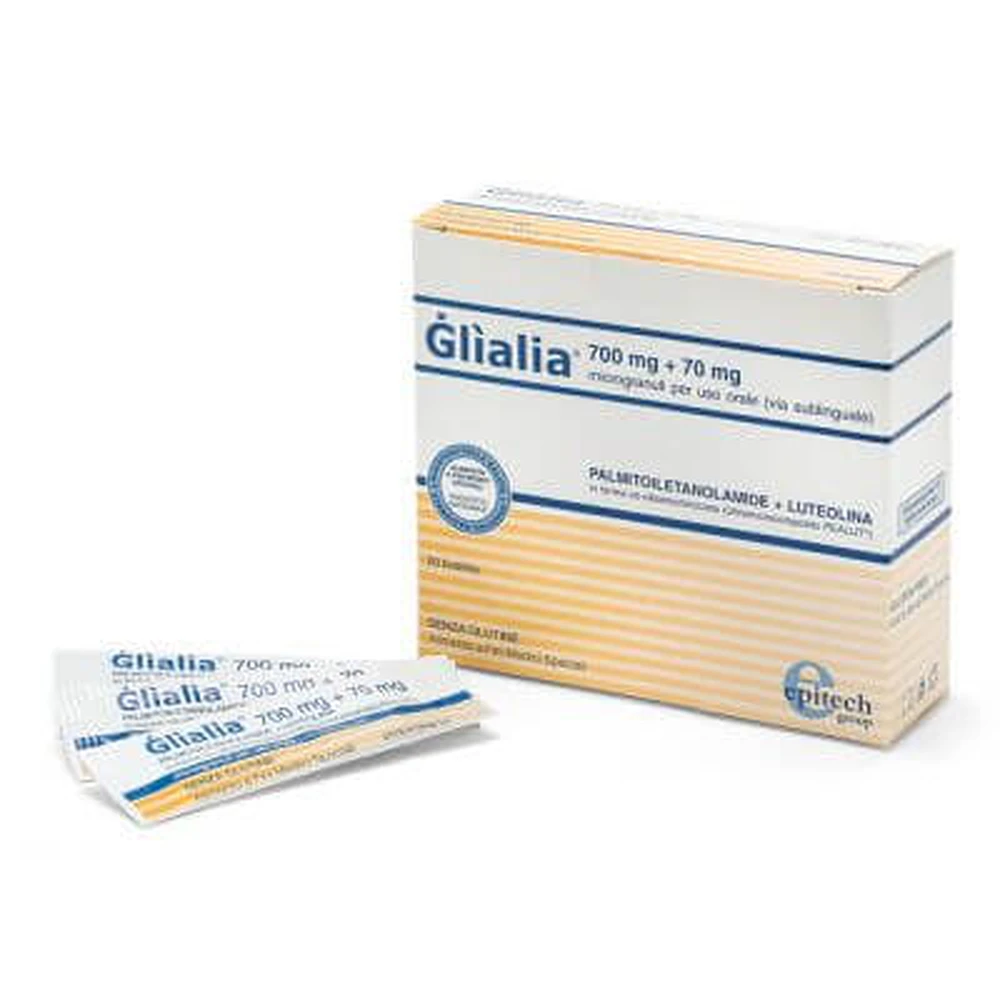
Glialia 700mg + 70mg microgranules oral use via sublingual route 20 sachets 1.27 g
Glialia 700mg + 70mg microgranules oral use via sublingual route 20 sachets 1.27 g
Description
Glìalia
Food for special medical purposes. Free from: gluten , lactose , sugars.Glìalia should be used under medical supervision in subjects with disorders caused by neuroinflammatory processes associated with: transient ischemic events (TIA); post-ictal ischemic states; post-traumatic CNS states; states of cognitive decline (Mild Neurocognitive Disorder - Mild-NCD); early-stage dementia; early-stage parkinsonism; inflammatory demyelinating diseases; motor neuron diseases; mood disorders.
Palmitoylethanolamide
It is a natural endogenous substance of a lipid nature with an N-acylethanolamide structure which has the function of intervening physiologically in the organism to maintain intersystemic tissue homeostasis.
Luteolin
It is also a natural substance belonging to the flavone family, endowed with considerable and peculiar antioxidant effects.
The combination of Palmitoylethanolamide and Luteolin in a co-ultramicronized form (PEALUT ultramicrocomposite) allows the two active ingredients to exert a synergistic effect in controlling neuroinflammation induced by various endogenous and exogenous noxae affecting the Central Nervous System. This control is achieved through the inhibitory modulation of non-neuronal cells—astrocytes, microglia, mast cells—normally responsible for ensuring the homeodynamic balance of the central nervous system.
Ingredients
| for 1 envelope | |
| Palmitoylethanolamide | 700 mg |
| Luteolin in co-ultramicronized form (PEALUT® Ultramicrocomposite) | 70 mg |
| Mixture of excipients (Sorbitol, Polysorbate 80, Sucrose Palmitate) | 500.00 mg |
How to use
Glìalia microgranules for sublingual use should be used under medical supervision following acute events associated with neuroinflammation in the CNS (post-ictal, post-traumatic situations) or, as an initial therapy, in the early stages of promptly diagnosed neurodegenerative diseases. It is recommended to take 2 sachets per day for 20-30 day cycles, which may be repeated, using the sublingual route whenever possible.
Warnings and precautions for use
Use under medical supervision.
The product cannot represent the sole source of nutrition.
Keep out of reach of children under 3 years.
Interactions: not highlighted.
Pregnancy: administration of the product is not recommended during confirmed or suspected pregnancy, due to insufficient adequate data regarding the use of the Palmitoylethanolamide and Luteolin combination in these situations.
Effects on ability to drive and use machines: Palmitoylethanolamide and Luteolin, at the recommended doses, do not interfere with the ability to drive and use machines.
Side effects: No side effects have been reported even following long-term administration and high doses of Palmitoylethanolamide, nor have there been any reports of habituation or dependence. In humans, administration of 100 mg/day of Luteolin for 4 months has proven to be well tolerated and safe.
Overdose: There are no known clinical cases of overdose.
Pharmacological properties
Health Authorization Category (Ministry of Health): Food for Special Medical Purposes.
Pharmacodynamic properties
Palmitoylethanolamide is an endogenous N-acylethanolamide, devoid of psychotropic effects. Preclinical studies have demonstrated that palmitoylethanolamide acts pleiotropically on neuroinflammation mechanisms, exerting an effective neuroprotective effect. The use of translational experimental models has clearly demonstrated that palmitoylethanolamide is able to affect central neuroinflammation through the synchronous modulation of non-neuronal cells (astrocytes, microglia, mast cells), thus determining effective neuroprotection.
Luteolin significantly normalizes the local oxidative state associated with neuroinflammation in the CNS. Available data demonstrate that the combination of Palmitoylethanolamide and Luteolin, administered as an ultramicrocomposite. Pealut, obtained by co-ultramicronization, is highly synergistic on the mechanisms of neuroinflammation in the CNS.
Mechanisms of action
Recent studies have demonstrated that the administration of Palmitoylethanolamide + Luteolin, in the form of the Pealut ultramicrocomposite obtained by co-ultramicronization in a 10:1 mass ratio, increases the cell viability of both macrophage and astrocyte cell lines subjected to oxidative stress. The Pealut ultramicrocomposite synergistically inhibits lipid peroxidation, mitochondrial dysfunction associated with cell apoptosis, nitric oxide (NO) production, and the expression of inducible enzymes (NO synthase and cyclooxygenase-2). Similar results were observed in organotypic hippocampal cultures damaged by the amyloid protein fragment Ab1-42. In ischemia models, the Pealut ultramicrocomposite has been shown to completely protect neurons from cell death, confirming the synergistic effect of the two molecules in the co-ultramicronized form. Pealut has demonstrated its efficacy in vivo in models of CNS trauma and mood alteration.
Pharmacokinetic properties
The temporal profile of palmitoylethanolamide in human plasma after a single oral dose of 300 to 1200 mg shows a dose-dependent increase in the molecule. Peak plasma levels of palmitoylethanolamide are observed one hour after dosing; plasma levels subsequently begin to decline and reach baseline within six hours. At one hour, plasma levels of palmitoylethanolamide double compared to baseline after a 300 mg dose, while they increase sevenfold after a 1200 mg dose. Experimental studies have shown that after oral administration, palmitoylethanolamide is uniformly distributed throughout tissues; a percentage of the administered dose crosses the blood-brain barrier and reaches brain tissue. Free luteolin has been detected in plasma in both experimental animals and humans after oral administration, demonstrating that some luteolin escapes first-pass degradation in the liver, which is avoided by sublingual administration. In rats, after oral administration, peak luteolin levels in plasma are reached after 1 hour, while peak excretion in feces and urine occurs around 8 hours.
Toxicology and Tolerability
Toxicology studies have shown that the LD/50 of Palmitoylethanolamide administered by injection (intraperitoneally) in dogs is greater than 400 mg/kg, and in rats, after a single administration by gastric tube, it exceeds 5000 mg/kg, while after repeated administration by gastric tube, it exceeds 500 mg/kg/day.
Clinical studies conducted on a significant number of patients demonstrate the excellent tolerability of palmitoylethanolamide, even at very high doses, and the absence of clinically relevant changes in hematological and blood chemistry tests. Toxicological studies in rats have demonstrated that administration of up to 1 g/kg of luteolin does not induce toxic effects. Chronic administration of luteolin at doses of 23, 48, and 87 mg/kg, respectively, for 26 weeks did not reveal any toxic effects related to body weight, hematological, blood chemistry, and histopathological tests.
Palmitoylethanolamide and embryotoxicity: No teratogenic or embryotoxic effects of palmitoylethanolamide were observed after administration of 50 mg/kg of body weight during pregnancy for 12 days. Furthermore, newborns of mothers who received PEA before delivery and up to 10 days after delivery were more resistant to Shigella shigae toxin. Similarly, newborns of mothers who received PEA postpartum demonstrated increasing resistance evident as early as 5 days after birth: these data suggest that mothers may have transferred PEA to their newborns through their milk.
Mutagenicity: Although a potential mutagenic effect of Palmitoylethanolamide can be excluded since it is already physiologically present in mammalian organisms, the mutagenicity of PEA was verified using the Ames test, using 5 mutant species of S. typhimurium (TA 1535-TA1537-TA1538-TA98 and TA 100). Using the Ames test, Palmitoylethanolamide, used at doses between 10,000 and 1,000 µg/ml, did not significantly alter the number of revertants. Luteolin also did not show mutagenic effects in the Ames test, using concentrations between 12.1 and 225.0 nmol/ml.
Palmitoylethanolamide and gastric tolerability: Oral administration of palmitoylethanolamide at a dose of 50 mg/kg (approximately 5 times higher than the active dose) and at a dose of 10 mg/kg in repeated administrations for 5 days does not induce ulcer formation. Furthermore, when administered at a dose of 50 mg/kg simultaneously with diclofenac 15 mg/kg, a dose known to induce gastric lesions, PEA decreases the ulcerogenic potential of NSAIDs, reducing the number of animals that develop ulcers and mitigating any damage.
Conservation
Store at room temperature.
Shelf life in unopened packaging: 36 months.
Format
Pack of 20 heat-sealed sachets.
Cod. 8060
Features
| Product code | 650645 |
| Category | Cerebral circulation, Nervous System, Products from Across Europe, Products from Italy |
| Product line | Glialia |
| Quantity | 20 |
| Delivery from | Italy |
Glialia 700mg + 70mg microgranules oral use via sublingual route 20 sachets 1.27 g
Glialia 700mg + 70mg microgranules oral use via sublingual route 20 sachets 1.27 g
Delivery from Italy
Italy 

Out of stock
We miss this item too 😢
Leave your email, and we’ll let you know as soon as it’s back in stock!
Leave your email, and we’ll let you know as soon as it’s back in stock!
I agree to receive notifications about this item and similar products





Reviews

Glialia 700mg + 70mg microgranules oral use via sublingual route 20 sachets 1.27 g
 Earn £1 Reward for every review
- For each submitted and approved review you can earn £1 Reward on your Rewards Credit.
- Rewards are given once for each purchased product you have reviewed.
- You have to be authorised to receive Rewards
All reviews

There are no reviews for this product.
Thank you for your review! It has been sent for moderation.















 Description