Promo code APP3 – £3 discount on your first order in app
  Free delivery for orders over £49


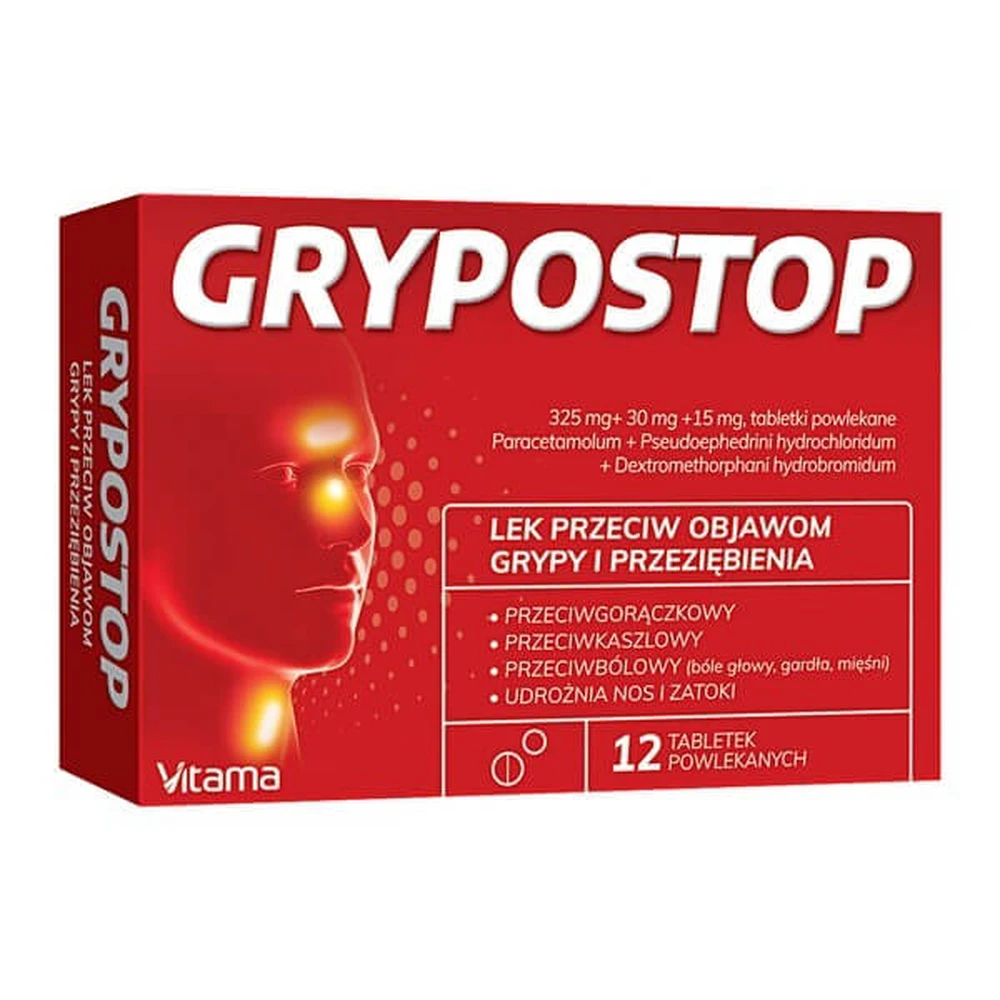
Grypostop, film-coated tablets, 12 pcs.
Description
Description
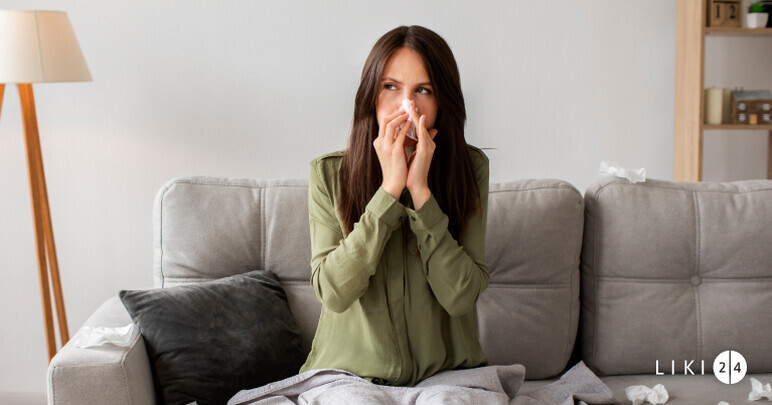
Grypostop is a multi-ingredient medication used for the emergency treatment of colds, flu-like illnesses, and influenza. It contains three active ingredients: paracetamol, dextromethorphan hydrobromide, and pseudoephedrine hydrochloride, providing antipyretic, analgesic, and antitussive effects, as well as clearing nasal passages and sinus congestion. Grypostop is intended for children over 12 years of age and adults.
Composition
The active substances of the drug are: paracetamol (Paracetamolum), pseudoephedrine hydrochloride (Pseudoephedrini hydrochloridum) and dextromethorphan hydrobromide (Dextromethorphani hydrobromidum).
1 film-coated tablet contains: 325 mg of paracetamol, 30 mg of pseudoephedrine hydrochloride and 15 mg of dextromethorphan hydrobromide.
Excipients: magnesium stearate, microcrystalline cellulose, polyvinylpyrrolidone (povidone), sodium starch glycolate (type A), potato starch, hydroxypropyl methylcellulose, polyethylene glycol, polysorbate 80, titanium dioxide.
Dosage
Always use this medicine exactly as described in the package leaflet or as directed by your doctor or pharmacist. If you have any further questions, ask your doctor or pharmacist.
A drug for oral use.
Usual dosage:
Children over 12 years of age and adults: 2 tablets as needed 3 or 4 times a day, not more often than every 4 hours.
Do not take more than 8 tablets per day.
Without consultation, the medicine can be used for a maximum of 3 days.
Action
Grypostop is a multi-ingredient medicinal product with comprehensive analgesic, antipyretic, and antitussive effects. It also unclogs the nasal passages and sinus cavities, and reduces mucous secretions, congestion, and swelling of the nasal mucosa.
Grypostop contains 3 active substances: paracetamol, pseudoephedrine hydrochloride and dextromethorphan hydrobromide.
Paracetamol is responsible for antipyretic and analgesic effects.
Pseudoephedrine reduces nasal congestion when taken orally.
Dextromethorphan has antitussive properties.
Indications
Emergency treatment of cold, flu and flu-like symptoms (fever, runny nose, cough, headache, sore throat, muscle and joint pain).
Contraindications
When not to use Grypostop :
- if you are allergic to the active substances or any of the other ingredients of this medicine,
- if you have severe liver or kidney failure,
- if you have anemia (low red blood cell count),
- if you are taking other medicines containing paracetamol, dextromethorphan, pseudoephedrine or other sympathomimetics,
- if you are also taking or have taken within the last two weeks medicines that inhibit a protein (enzyme) called monoamine oxidase (so-called MAO inhibitors),
- in children up to 12 years of age, during pregnancy and breastfeeding,
- if you have a cough with a lot of sputum,
- if you suffer from bronchial asthma and cough associated with bronchial asthma,
- if you have severe hypertension, severe coronary heart disease, if you suffer from cystic fibrosis.
Side effects
Like all medicines, this medicine can cause side effects, although not everybody gets them.
Rare side effects (1 to 10 in 10,000 patients):
- drowsiness, dizziness,
- euphoria,
- excessive sedation, feeling of lightheadedness,
- anxiety, nervousness, irritability, mood disorders, psychomotor agitation,
- nausea, vomiting, abdominal pain, constipation,
- allergic reactions.
Very rare side effects (less than 1 in 10,000 patients):
- agranulocytosis, thrombocytopenia, neutropenia.
Unknown frequency of side effects (cannot be estimated based on available data):
- Sudden fever, skin redness or numerous small spots may occur within the first 2 days of using Grypostop .
Warnings and precautions
If excessive nervousness, dizziness, or insomnia occur, discontinue use and consult a doctor.
Do not use doses higher than recommended.
You should not drink alcohol while taking this medicine due to the increased risk of liver damage.
Do not use other drugs that depress the central nervous system (e.g. sleeping pills, sedatives).
If you develop fever with generalized skin erythema and pustular rash, stop taking Grypostop and contact your doctor or seek medical attention immediately.
You should consult your doctor if:
- patients with liver and/or kidney failure;
- elderly people, as the risk of side effects from the nervous system increases;
- in patients who are weakened or immobilized for a long time;
- patients who experience breathing difficulties;
- in patients with emphysema, asthma, chronic bronchitis, prostatic hyperplasia, hyperthyroidism, diabetes, high blood pressure, heart disease, arterial disease, closed-angle glaucoma or pheochromocytoma.
Use of other medications
Tell your doctor or pharmacist about all the medicines you are taking, have recently taken or might take.
The product should not be used together with other medicines containing: paracetamol, dextromethorphan or pseudoephedrine or other sympathomimetics.
Grypostop may interact with:
- drugs that accelerate gastric emptying - they accelerate the absorption of paracetamol,
- drugs that delay gastric emptying and all cholinolytic drugs - they may delay the absorption and action of paracetamol in the body,
- narcotic painkillers - they delay the absorption of paracetamol into the blood,
- salicylamide - it prolongs the action of paracetamol,
- sleeping pills and sedatives - increased analgesic effect,
- drugs such as propranolol, nizatidine, zidovudine or probenecid – they increase the effect of pseudoephedrine (sympathomimetics), and there is also a greater likelihood of harmful effects of paracetamol by increasing its concentration in the blood,
- orally administered salbutamol - reducing the rate of paracetamol absorption,
- drugs used in diabetes and anticoagulants – intensification of the effect of these drugs,
- chloramphenicol - paracetamol may increase its harmful effects,
- rifampicin, antiepileptic drugs, barbiturates and other drugs affecting metabolism in the liver – when used concomitantly with paracetamol, the risk of liver damage increases,
- MAO inhibitors - they increase the effect of pseudoephedrine (sympathomimetics), so a 14-day interval should be maintained between use, in addition, paracetamol may cause an increase in blood pressure, heart rhythm disturbances, agitation and fever,
- other sympathomimetic drugs (bronchodilators) - pseudoephedrine intensifies their effect,
- methyldopa, guanethidine and reserpine – pseudoephedrine weakens their effect,
- tricyclic antidepressants - they intensify the effect of pseudoephedrine,
- aluminum hydroxide (used e.g. for heartburn) - increased absorption of pseudoephedrine,
- kaolin - reduced absorption of pseudoephedrine,
- Dextromethorphan may increase the effects of MAO inhibitors, central nervous system depressants, alcohol, and constipating drugs.
- Drugs such as amiodarone, haloperidol, propafenone, quinidine, fluoxetine, venlafaxine, risperidone may increase the concentration of dextomethorphan in the blood.
- Dextromethorphan administered concomitantly with lidocaine or nonsteroidal analgesics may potentiate their effects.
Taking the medicine with food and drink
Food may delay the absorption of paracetamol.
Dextromethorphan may increase the effects of alcohol.
Pregnancy and breastfeeding
Please tell your doctor or pharmacist about all the medicines you are taking, have recently taken or might take, including medicines obtained without a prescription.
The use of Grypostop during pregnancy and breastfeeding is contraindicated.
Use of the drug in children and adolescents
Not to be used in children under 12 years of age.
Driving and operating machinery
Grypostop may affect your ability to drive or operate machinery. Caution should be exercised when driving or operating machinery while taking this medicine.
Features
| Product code | 755554 |
| Category | Skincare and beauty, Dermatology |
| Quantity | 12 |
| Product type | Tablets |
| Delivery from | Poland |
Grypostop, film-coated tablets, 12 pcs.
Grypostop, film-coated tablets, 12 pcs.
Delivery from Poland


Leave your email, and we’ll let you know as soon as it’s back in stock!
Recently viewed products

Reviews

Grypostop, film-coated tablets, 12 pcs.
 Earn £1 Reward for every review
- For each submitted and approved review you can earn £1 Reward on your Rewards Credit.
- Rewards are given once for each purchased product you have reviewed.
- You have to be authorised to receive Rewards
All reviews

There are no reviews for this product.










 Description