Promo code APP3 – £3 discount on your first order in app
  Free delivery for orders over £49


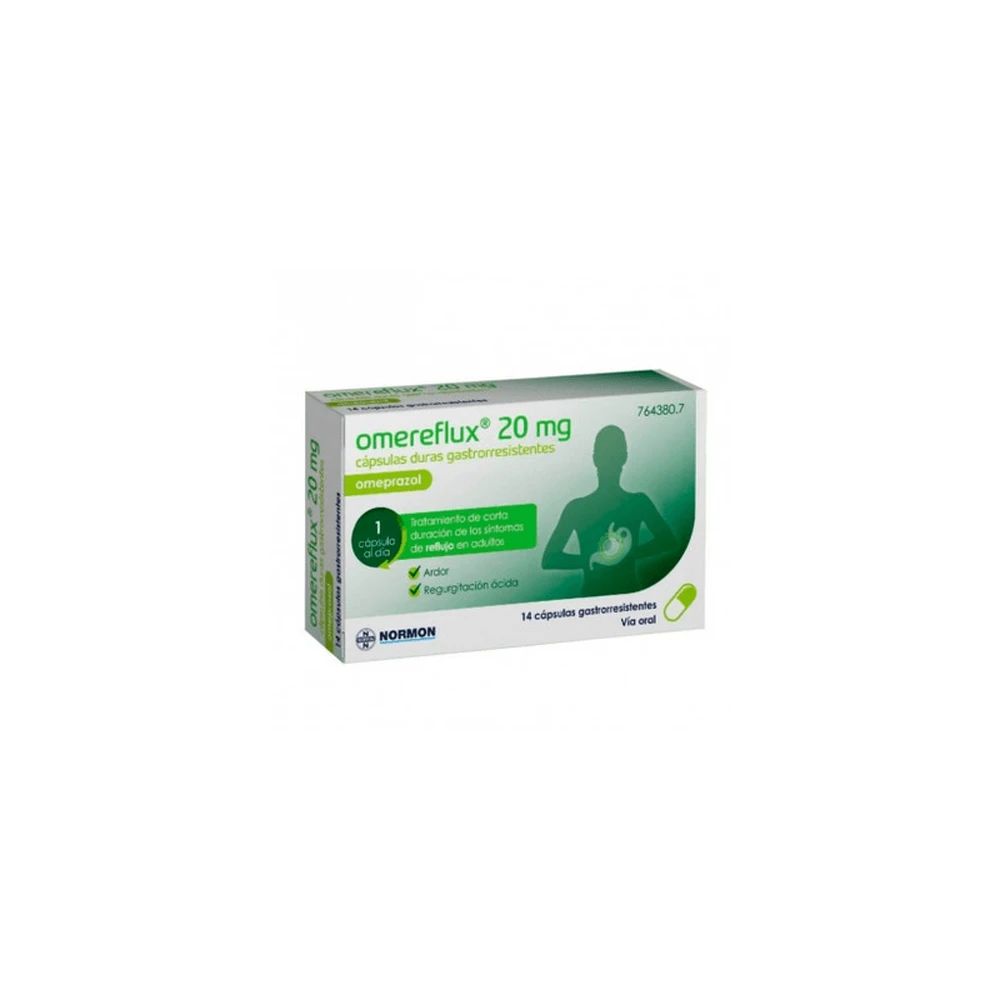
OMEREFLUX 20 MG 14 GASTRORESISTANT CAPSULES
Description
ACTION AND MECHANISM
- Anti-peptic ulcer, H+/K+ pump inhibitor. Omeprazole is a benzimidazole that acts as a specific, non-competitive, and irreversible inhibitor of the proton pump (PPI) or H+/K+ ATPase, located on the surface of the gastric parietal cell. Blocking this proton pump prevents the production of gastric acid, both basally and in response to a stimulus, regardless of the stimulus (acetylcholine, gastrin, or histamine).
Omeprazole is a racemic mixture of two stereoisomers, S-omeprazole (esomeprazole, pharmacologically active) and R-omeprazole (with no activity on acid production).
Omeprazole is a prodrug with a weak base nature, which, after absorption, is distributed throughout the body, particularly into the lumen of the secretory canaliculi of the parietal cell. Here, in the presence of an acidic environment, it undergoes a non-enzymatic chemical reaction, yielding the active form, a fully hydrophilic sulfonamide derivative, which tends to accumulate in the canaliculi and bind to the proton pump via disulfide bridges with cysteine residues of the alpha-luminal chain.
Due to the formation of covalent bonds, the only way for the parietal cell to recover its secretory activity is by synthesizing new pumps, which takes a long time and explains the long duration of the effects of PPIs, which can last up to 4 days after the administration of a single dose, despite their low t1/2.
Administration of a 20 mg dose of omeprazole resulted in a 70% reduction in pentagastrin-induced acid secretion 24 h after administration.
The effects on acid production begin to appear after 2 hours, although it may take up to 5 days to reach maximum anti-ulcer activity. Its effects can be prolonged, and some studies have shown an inhibition of acid secretion of 26% (20 mg) and 48% (mg) 24 hours after administration.
SPECIAL WARNINGS
- It is recommended to confirm the healing of the ulcerations by endoscopy before discontinuing treatment.
Proton pump inhibitors (PPIs) may mask the symptoms of esophageal or gastric tumors. Close monitoring is recommended for patients treated with a PPI for extended periods (longer than one year). If the patient experiences symptoms such as significant and unexplained weight loss, frequent vomiting, dysphagia, hematemesis, or melena, a differential diagnosis is recommended.
- In the event of severe and prolonged diarrhea, possible Clostridium difficile infection will be investigated.
- Prolonged treatment with PPIs has rarely resulted in severe cases of hypomagnesemia, which may be associated with hypocalcemia. If the patient experiences symptoms such as weakness, dizziness, tetany, seizures, or cardiac arrhythmia, magnesium levels should be determined, and in cases of hypomagnesemia, treatment should be discontinued and a magnesium supplement administered.
Anti-ulcer drugs may interfere with the diagnosis of neuroendocrine tumors by increasing levels of the specific marker chromogranin A (CgA), leading to false negatives. Discontinue the anti-ulcer drug at least 5 days before the test, and if levels have not normalized, repeat the test 14 days after discontinuation.
- Monitoring:
* Baseline and periodic magnesium levels in patients treated for long periods with omeprazole, treated with digoxin or with drugs that could lead to hypomagnesemia, such as diuretics.
PATIENT ADVICE
Do not stop treatment until instructed by your doctor, even if your symptoms have disappeared. Stopping treatment prematurely could cause your symptoms to return.
- Inform your doctor about any medications you are taking.
- Inform your doctor and/or pharmacist if you experience any of these symptoms:
* Severe and/or persistent diarrhea.
* Significant and unexplained weight loss, frequent vomiting, difficulty swallowing, or the presence of blood in vomit or stool.
* Unexplained tiredness, dizziness, muscle stiffness, seizures, or cardiac arrhythmias.
* Appearance of skin lesions, especially in areas exposed to the sun, accompanied by joint pain.
CONTRAINDICATIONS
- Hypersensitivity to omeprazole, to any other PPI, or to any other component of the medicine.
- Concomitant treatment with nelfinavir (see Interactions – Protease inhibitors).
ADVANCED AGE
No specific problems have been described in the elderly that would require a dosage adjustment.
EFFECTS ON DRIVING
It does not appear to have significant side effects. Dizziness is uncommon, and blurred vision and vertigo are rare.
PREGNANCY
Animal safety : Omeprazole did not result in teratogenicity when administered to pregnant rats or rabbits at doses 345 and 172 DMRH, although an increase in fetal mortality was observed.
Safety in humans : The gestational safety of PPIs (including lansoprazole, omeprazole, and pantoprazole) has been evaluated in several clinical trials and meta-analyses, and no teratogenic effects or embryotoxicity have been found, although these cannot be completely ruled out, especially in the case of rare or delayed fetal adverse reactions. However, based on information obtained from animal studies, the risk would not be very high.
Omeprazole crosses the placenta. It is recommended to use it with caution, restricting its use to situations where there are no safer therapeutic alternatives, and the benefits outweigh the potential risks.
Effects on fertility : Animal studies show no effects on fertility.
PHARMACOKINETICS
Omeprazole is a prodrug, and after its absorption and distribution to the parietal cell, it is transformed by a chemical reaction catalyzed in an acidic medium into the active sulfonamido derivative.
INDICATIONS
- [GASTROESOPHAGEAL REFLUX]:
* Treatment of erosive reflux esophagitis.
* Symptomatic treatment of GERD.
* Prevention of long-term relapses in patients with healed esophagitis.
INTERACTIONS
- Oral anticoagulants. Cases of increased INR have been reported in patients treated with an anticoagulant and a PPI. Use with caution is recommended, with INR monitoring.
Clopidogrel. High doses of omeprazole may decrease the effect of clopidogrel by inhibiting its transformation to its active metabolite, a process mediated by CYP2C19 (although other mechanisms may exist, as clopidogrel has several metabolic pathways). The combination of omeprazole and clopidogrel should be avoided. Pantoprazole, and to a lesser extent lansoprazole and rabeprazole, may be safer alternatives.
- Disulfiram. A case of catatonic reaction has been described when combined with omeprazole.
- Drugs with pH-dependent absorption. The increase in pH produced by antiulcer drugs could modify the absorption of certain medications by favoring or reducing their dissolution in the aqueous environment of the gastric contents. Thus, an increase in the absorption of digoxin has been observed, as well as a reduction in the absorption of azole antifungals (itraconazole, ketoconazole, posaconazole), mycophenolate mofetil, rilpivirine, vitamin B12, and tyrosine kinase inhibitors (dasatinib, erlotinib, gefitinib, lapatinib, nilotinib, pazopanib).
Digoxin toxicity is rare, but given its serious effects, caution is advised in elderly patients treated with high doses. Monitoring of plasma digoxin levels is recommended.
- Enzyme inducers/inhibitors. Omeprazole is metabolized by CYP2C19 and, to a lesser extent, by CYP3A4. Therefore, its plasma levels could be altered by potent inhibitors (fluconazole, fluvoxamine, ticlopidine) or inducers (rifampicin) of both isoenzymes. There are also certain risks associated with drugs that affect only one isoenzyme, especially CYP2C19, which is the most prevalent. A dosage adjustment is not considered necessary, as the effect would be similar to that observed in poor metabolizers, but it could be more significant in cases of severe hepatic impairment and long-term treatment.
- Protease inhibitors (PIs). PPIs may alter plasma levels of certain PIs, either by increasing pH or by inhibiting CYP2C19.
Significant reductions in plasma levels of nelfinavir and atazanavir have been reported. Co-administration with nelfinavir is contraindicated, and combination with atazanavir is not recommended. If this combination cannot be avoided, increasing the atazanavir dose from 300 to 400 mg is recommended, although this dose increase did not completely counteract the effect on plasma levels of atazanavir; therefore, the patient's response should be evaluated.
An increase in saquinavir levels of up to two times has been described.
Finally, no significant pharmacokinetic alterations were observed when combined with amprenavir, darunavir, fosamprenavir, lopinavir, or tipranavir.
- Methotrexate. PPIs may increase serum methotrexate levels.
- CYP2C19 substrates. Omeprazole is a moderate inhibitor of CYP2C19, so it could increase plasma levels of drugs metabolized by this system, such as certain tricyclic antidepressants (clomipramine, imipramine), cilostazol, citalopram, diazepam, phenytoin, voriconazole, or warfarin. It may be necessary to reduce the doses of these drugs, especially in cases of on-demand proton pump inhibitor (PPI) therapy.
In the case of phenytoin and warfarin, it would also be advisable to monitor their plasma levels when starting and finishing treatment with omeprazole.
- Tacrolimus. Increased serum levels of tacrolimus have been reported when administered with omeprazole.
No drug interactions have been found when combining with antacids, beta-blockers (metoprolol, propranolol), domperidone, fluoroquinolones or theophylline.
LACTATION
Animal safety : Administration to lactating rats (35-345 MDRH) was associated with reduced pup weight gain.
Safety in humans : Omeprazole is excreted in breast milk, reaching levels of up to 7% of maternal plasma volume. The consequences for the infant are unknown, although it should be noted that proton pump inhibitors (PPIs) are labile drugs in acidic pH, which is why they are administered orally in gastro-resistant forms. It is recommended to discontinue breastfeeding or avoid administering the drug.
CHILDREN
Omeprazole has been used orally for the treatment of reflux esophagitis and the symptomatic treatment of esophagitis in children from 1 year of age and at least 10 kg in weight, as well as for the eradication of H. pylori in children and adolescents from 4 years of age.
Its use is not recommended for other indications or at ages other than those established in the approved indications.
GUIDELINES FOR PROPER ADMINISTRATION
- Gastro-resistant capsules: Swallow whole with half a glass of liquid. Do not chew, crush, or break.
If the patient has difficulty swallowing the capsules, they can be opened and sucked out, or their contents can be suspended in half a glass of still water, fruit juice, or soft foods such as yogurt or applesauce. The suspension with the granules should be drunk immediately or within 30 minutes. Then, fill the glass halfway with water and drink the contents completely. The granules should not be chewed or crushed.
Administration with food : preferably administer on an empty stomach, first thing in the morning.
POSOLOGY
"ORAL ADMINISTRATION"
- Adults:
DOSAGE IN HEPATIC INSUFFICIENCY
A dose of 10-20 mg/24 h is usually sufficient.
DOSAGE IN RENAL INSUFFICIENCY
No dosage adjustment is required.
PRECAUTIONS
- [HEPATIC IMPAIRMENT]. Hepatic impairment may increase exposure due to reduced first-pass hepatic metabolism and decrease elimination due to reduced metabolism. However, omeprazole has been shown not to accumulate in these patients when administered once daily. Caution is advised. Patients with hepatic impairment may require a lower maintenance dose.
- [DIGESTIVE INFECTIONS]. The increase in gastric pH produced by anti-ulcer drugs may favor the colonization of the digestive tract by certain pathogenic microorganisms, such as Salmonella, Campylobacter, and even Clostridium difficile in hospitalized patients. A differential diagnosis of [PSEUDOMEMBRANOUS COLITIS] is recommended in patients treated with an anti-ulcer drug who develop severe diarrhea.
- [CYANOCOBALAMIN DEFICIENCY]. The increased pH produced by anti-ulcer drugs could decrease the absorption of cyanocobalamin, so it is recommended to take this into account in people with low stores of this vitamin, such as patients with [MALNUTRITION] or strict vegetarian diets without supplementation of this vitamin, or situations in which its absorption could be reduced, such as [CHRONIC ALCOHOLISM], [INTESTINAL MALABSORPTION] or situations that could lead to malabsorption, such as [INFLAMMATORY BOWEL DISEASE] or major surgical procedures of the digestive system.
- [HYPOMAGNESEMIA]. Treatment with PPIs has been linked to the occurrence of severe cases of hypomagnesemia, which may be associated with [HYPOCALCEMIA]. Its frequency has not been estimated, but it is considered rare. However, the widespread use of these drugs should be taken into account, so their clinical impact could be significant. Most patients who developed hypomagnesemia were on long-term treatment (at least 3 months and primarily 1 year).
It is recommended to monitor magnesium levels at the start of treatment and periodically throughout treatment in patients on long-term PPI therapy, digoxin therapy, or drugs that could lead to hypomagnesemia, such as diuretics.
If symptoms of hypomagnesemia appear, such as fatigue, dizziness, tetany, delirium, seizures, or cardiac arrhythmia, magnesium levels will be determined. Hypomagnesemia responds to discontinuation of the proton pump inhibitor (PPI) and administration of magnesium supplements.
- [OSTEOPOROSIS]. The administration of high doses of PPIs for prolonged periods (> 1 year) has been associated with an increased risk of hip, wrist, and vertebral fractures, especially in elderly individuals and those with risk factors. Therefore, it is recommended that women with osteoporosis receive treatment and adequate calcium and vitamin D supplementation.
- [PNEUMONIA]. Treatment with PPIs has been associated with cases of pneumonia, including community-acquired pneumonia (CAP), interstitial pneumonia, and nosocomial pneumonia. The risk appears to be higher in patients who have recently started treatment (especially < 2 days), rather than with long-term treatment.
- [SUBACUTE CUTANEOUS LUPUS ERYTHEMATOSUS] (SCL). PPIs have been associated with very rare cases of subacute cutaneous lupus erythematosus. If skin lesions appear, especially in sun-exposed areas, accompanied by arthralgia, consider discontinuing treatment. Patients with SCL due to a PPI may experience this condition again if they receive a different PPI.
- Analytical interferences. The increase in gastric pH induced by antiulcer drugs can increase plasma levels of gastrin (which usually return to baseline levels 4 weeks after discontinuing treatment) and chromogranin A (CgA).
CgA is a specific marker for neuroendocrine tumors, so anti-ulcer drugs could lead to false positives when this marker is used in diagnostic tests. Therefore, any anti-ulcer medication should be discontinued at least 5 days before the CgA measurement. If CgA levels have not normalized within this period, the test should be repeated 14 days after discontinuing the anti-ulcer drug.
- Long-term treatment. Anti-ulcer drugs eliminate the symptoms related to acid-related diseases, which are common to malignant processes such as stomach cancer or esophageal cancer. Therefore, there is a risk of delaying the diagnosis of these conditions.
Patients undergoing prolonged treatment (more than one year) are recommended to be monitored regularly and advised to report any other symptoms associated with these neoplasms, such as significant and unexplained weight loss, recurrent vomiting, dysphagia, or vomiting blood or stool. A differential diagnosis is recommended if a serious gastrointestinal condition is suspected.
- Renal impairment: Acute tubulointerstitial nephritis has been observed in patients taking omeprazole and can occur at any time during treatment with omeprazole (see section 4.8). Acute tubulointerstitial nephritis may progress to renal failure.
- Skin reactions such as [TOXIC EPIDERMAL NECROLYSIS] or [STEVENS-JOHNSON SYNDROME], which can be fatal or life-threatening, have been reported as rare or very rare.
PRECAUTIONS RELATING TO EXCIPIENTS
This medicine contains sucrose. Patients with hereditary fructose intolerance, glucose-galactose malabsorption, or sucrase-isomaltase deficiency should not take this medicine.
ADVERSE REACTIONS
Adverse reactions to omeprazole appear to be dose-independent. The most frequent are gastrointestinal in nature, as well as headache.
In the trials conducted, the safety profile in children was similar to that observed in adult patients. There are no long-term safety data in children, nor data on the effects on growth.
Adverse reactions are described according to each frequency interval, being considered very common (>10%), common (1-10%), uncommon (0.1-1%), rare (0.01-0.1%), very rare (<0.01%) or of unknown frequency (cannot be estimated from the available data).
- Digestive: frequent [NAUSEA] and [VOMITING], [ABDOMINAL PAIN], [CONSTIPATION], [DIARRHEA], [FLATULENCE]; rare [DRY MOUTH], [STOMATITIS], [CANDIDIASIS]; frequency unknown [PANCREATITIS].
- Hepatic: uncommon [INCREASE TRANSAMINASES]; rare [HEPATITIS] with or without [JAUNDICE]; very rare [HEPATIC FAILURE], [HEPATIC ENCEPHALOPATHY] in patients with previous liver disease; frequency unknown [CHOLESTASIS].
- Cardiovascular: frequency unknown [HIGH PRESSURE], [PALPITATIONS], [ANGINA], [RAYNAUD'S SYNDROME].
- Neurological/psychological: frequent [HEADACHE]; infrequent [DIZZINESS], [PARESTHESIA], [DROWSY], [INSOMNIA]; rare [NERVOUSNESS], [CONFUSION], [DEPRESSION], [DYSGEUSIA]; very rare [HALLUCINATIONS], [AGGRESSIVENESS]; frequency unknown [ATAXIA].
- Respiratory: frequent [COUGH], [RESPIRATORY INFECTION]; rare [BRONCHOSPASM]; frequency unknown [PNEUMONIA].
- Genitourinary: rare [INTERSTITIAL NEPHRITIS]; very rare [GYNECOMASTIA]; frequency unknown [GALACTORRHEA], [INCREASE IN SERUM CREATININE].
- Dermatological: uncommon [DERMATITIS], [PRURITUS], [SKIN ERUPTIONS], [URTICARIA]; rare [ALOPECIA], [PHOTOSENSITIVITY REACTIONS], acute generalized exanthematous pustulosis, [DRESS SYNDROME]; very rare [ERYTHEMA MULTIFORME], [TOXIC EPIDERMAL NECROLYSIS], [STEVENS-JOHNSON SYNDROME], acute generalized exanthematous pustulosis; frequency not known [ANGIOEDEMA]; frequency not known [SUBACUTE CUTANEOUS LUPUS ERYTHEMATOSUS].
- Allergic: rare [HYPERSENSITIVITY REACTIONS], with [FEVER], [ANGIOEDEMA] or [ANAPHYLAXIS], and [LUPUS ERYTHEMATOSUS].
- Musculoskeletal: common [BACK PAIN]; uncommon [HIP FRACTURE], [VERTEBRAL FRACTURE] or wrist fracture; rare [MUSCULOSKELETAL PAIN], [MYALGIA]; very rare [MYASTHENIA]; frequency unknown [RHABDOMYOLYSIS].
- Ophthalmological: rare [BLURRED VISION]; frequency unknown [OPTIC NEURITIS], [OPTIC NEUROPATHY].
- Optic: uncommon [VERTIGO].
- Hematological: rare [LEUKOPENIA], [THROMBOCYTOPENIA]; very rare [AGRANULOCYTOSIS], [PANCYTOPENIA]; frequency unknown [NEUTROPENIA], [HEMOLYTIC ANEMIA] or [MEGALOBLASTIC ANEMIA].
- Metabolic: rare [HYPONATREMIA]; frequency unknown [HYPOMAGNESEMIA], [HYPERCALCEMIA], [HYPOGLYCEMIA], [HYPOKALEMIA], [CYANOCOBALAMIN DEFICIENCY], [WEIGHT GAIN].
Hypomagnesemia can present with asthenia, dizziness, tetany, delirium, seizures, or cardiac arrhythmia, among other symptoms. If symptoms appear, magnesium levels should be determined. Hypomagnesemia responds to discontinuing the proton pump inhibitor (PPI) and administering magnesium supplements.
- General: frequent [ASTHENIA], [FEVER]; infrequent [GENERAL MALAISE], [ANELEOLAR EDEMA]; rare [HYPERHIDROSIS].
OVERDOSE
Symptoms : Single doses of up to 2,400 mg, equivalent to 120 MRHD, have been administered. No serious or irreversible adverse reactions have been reported, and in most cases patients experienced symptoms such as nausea and vomiting, abdominal pain, diarrhea, dizziness, headache, depression, apathy, or confusion.
Measures to be taken :
- Antidote: there is no specific antidote.
- General elimination measures: administer activated charcoal in cases of very severe poisoning, although this is not usually necessary. It is not expected to be easily dialyzable due to its high plasma protein binding.
- Monitoring: patient's clinical status.
- Treatment: symptomatic.
Features
| Product code | 585313 |
| Category | Teas for diseases, Drinks, Products from Across Europe, Products from Spain |
| Quantity | 14 |
| Dose | 20 mg |
| Delivery from | Spain |
OMEREFLUX 20 MG 14 GASTRORESISTANT CAPSULES
OMEREFLUX 20 MG 14 GASTRORESISTANT CAPSULES
Delivery from Spain

 12 - 21 Oct

 Guaranteed delivery from Spain: 12 - 21 October
-
£5.80Delivery: £5.99 (free from £49)
Delivery from Spain:
12 - 21 October
-
 Pay securely with your preferred payment method

















Reviews

OMEREFLUX 20 MG 14 GASTRORESISTANT CAPSULES
 Earn £1 Reward for every review
- For each submitted and approved review you can earn £1 Reward on your Rewards Credit.
- Rewards are given once for each purchased product you have reviewed.
- You have to be authorised to receive Rewards
All reviews

There are no reviews for this product.















 Description