Promo code APP3 – £3 discount on your first order in app
  Free delivery for orders over £49


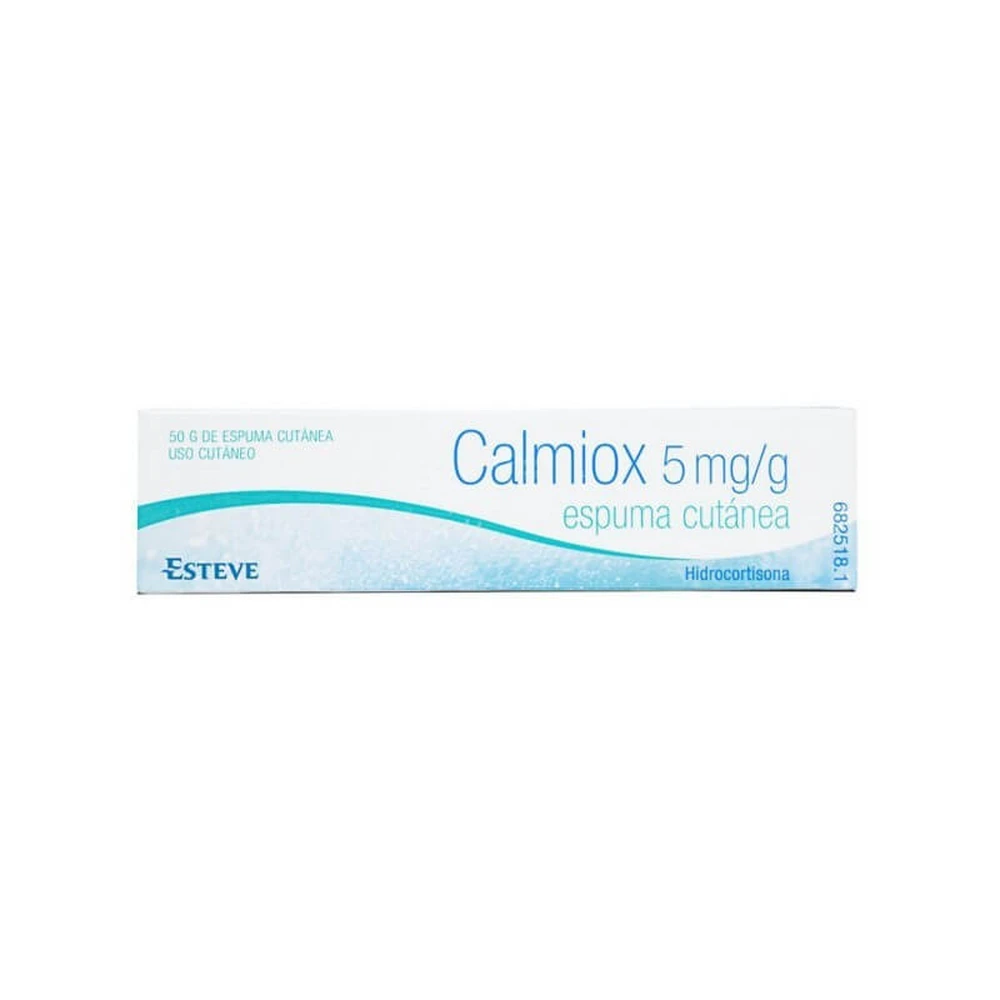
CALMIOX 5 MG/G TOPICAL SPRAY FOAM 50 G
Description
ACTION AND MECHANISM
Hydrocortisone is a non-fluorinated corticosteroid whose potency varies depending on the salt used, from low potency (in base and acetate form) to moderate potency (butyrate, buteprate) or high potency (aceponate). Several pharmacological activities have been described that may be useful in skin disorders:
- Anti-inflammatory. They exhibit potent and non-specific anti-inflammatory activity against most inflammatory causes, including mechanical, chemical, immunological or microbiological agents.
The effect appears to be due to binding to intracellular steroid receptors, forming a complex that stimulates the production of the lipocortin (or macrocortin) protein, which acts as an inhibitor of phospholipase A2. This results in a reduction in the production of certain pro-inflammatory mediators derived from arachidonic acid, such as prostaglandins and leukotrienes.
In addition to this direct effect on production, they also reduce the release of pro-inflammatory factors such as kinins, histamine, liposomal enzymes, prostaglandins, or leukotrienes.
- Vasoconstrictor. Its topical application reduces the migration of macrophages and leukocytes to injured areas, reverses vasodilation, and decreases vascular permeability. These effects reduce edema, erythema, and pruritus.
- Antiproliferative. They suppress DNA synthesis, exerting an antimitotic effect that reduces the tissue hyperplasia characteristic of psoriatic processes.
- Immunosuppressant. This could be due to the inhibition of cytokine synthesis and a possible antimitotic effect.
SPECIAL WARNINGS
- Use on large areas, for prolonged periods of time, or under occlusive conditions (including diapers or areas with skin folds) may result in systemic effects. It is recommended to avoid these conditions of use, and if this is not possible, to limit the duration of treatment to a minimum.
- There is a risk of rebound effect and adrenal suppression if the corticosteroid is abruptly discontinued. Discontinue gradually or replace with a less potent corticosteroid.
SENIORS
No specific problems have been described in the elderly. However, elderly patients are more susceptible to the systemic adverse effects of corticosteroids, so caution is advised.
In the case of patients who use diapers, the application of corticosteroids to areas covered by the diaper should generally be avoided.
PATIENT ADVICE
- Respect the doses and duration of treatment prescribed by your doctor.
Do not apply to eyes, open wounds, mucous membranes, or areas of skin with folds or that will be covered, such as areas covered by diapers. In case of accidental contact with the eyes, rinse them with plenty of water.
- Wash your hands after administration.
- Maintain good hygiene in the administration area.
Do not stop treatment abruptly. Consult your doctor about how to discontinue the corticosteroid.
- Notify your doctor and/or pharmacist if you experience any symptoms of infection in the application area.
CONTRAINDICATIONS
- [ALLERGY TO CORTICOSTEROIDS] or to any other component of the medication.
- Direct application to skin areas using one of the following processes:
* Active [SKIN INFECTION], such as [HERPESVIRUS INFECTION], [CHICKENPOX], [CUTANEOUS TUBERCULOSIS] or areas with skin disorders associated with syphilis (see Precautions; Skin Infections).
* [ROSACEA], [PERIORAL DERMATITIS], [SKIN ULCER], [BURNS], [SKIN ATROPHY] or [ACNE], which could be aggravated by the use of topical corticosteroids.
* Hypersensitivity reaction following vaccine administration.
EFFECTS ON DRIVING
Hydrocortisone does not appear to affect the ability to drive.
PREGNANCY
FDA Category C.
Animal safety: Administration of corticosteroids in experimental animals has resulted in teratogenic and embryotoxic effects when used at doses higher than recommended.
Safety in humans: Adequate and well-controlled studies in humans are not available. Although some authors state that the use of corticosteroids produces a 1% incidence of cleft palate, in general, studies in humans with systemic corticosteroids have not been able to confirm the teratogenicity observed in animals.
Hydrocortisone is metabolized in the placenta, so fetal exposure after topical application is not expected to be high.
As a general rule for topical corticosteroids, their use is not recommended during the first trimester of pregnancy, and the benefit/risk ratio should be carefully assessed during the last two trimesters. If used, the lowest possible dose should be used, and close monitoring for adrenal insufficiency in the newborn is recommended.
Effects on fertility: no specific studies have been conducted in humans.
PHARMACOKINETICS
Topical route:
- Absorption: Topical corticosteroids are absorbed through the skin, with absorption varying depending on factors such as the physicochemical properties of the molecule, the characteristics of the pharmaceutical form, the thickness and condition of the skin (greater absorption in areas of thin skin such as the face and genitals or in cases of wounds, inflammation) or the method of application (greater absorption under occlusive conditions).
- Distribution: high binding to plasma proteins (90%), primarily to transcortin or steroid-binding globulin. When this transporter becomes saturated, it also binds to albumin. The Vd is 34 L.
- Metabolism: extensive systemic and hepatic metabolism, resulting in a multitude of inactive metabolites such as hydrocortisone glucuronides or sulfates.
Enzyme inducing/inhibiting capacity: does not appear to have a significant effect.
- Excretion: mainly in urine (< 1% unchanged). Its CLt is 18 l/h and t1/2 1-2 h.
Pharmacokinetics in special situations: no specific data are available in children, the elderly or patients with renal or hepatic impairment.
INDICATIONS
- Symptomatic treatment of skin [PRURITUS] due to minor skin irritations, [ALLERGIC CONTACT DERMATITIS] caused by soaps, detergents, metals, insect bites and nettles.
INTERACTIONS
They have not been established.
LACTATION
Animal safety: no data available.
Safety in humans: it is unknown whether it is excreted in milk, although systemic corticosteroids are, and cases of growth retardation in infants have been described.
Although adverse reactions in the infant are unlikely after the local application of a corticosteroid to the mother for short periods of time, it is advisable to restrict its use exclusively to situations where there are no safer therapeutic alternatives and the benefits to the mother outweigh the possible risks to the infant.
Avoid direct application to the breasts before breastfeeding. If applied to the nipples, they should be washed before breastfeeding to remove any traces of the corticosteroid. Following two months of nipple application of a corticosteroid with high mineralocorticoid activity (isoflupredone acetate), Cushing's syndrome, hypertension, QT interval prolongation, electrolyte imbalances, and growth retardation in infants were reported.
CHILDREN
Children, especially young children, experience greater cutaneous absorption of corticosteroids due to the immaturity of their skin barrier. Therefore, they may be more susceptible to adverse reactions to topical corticosteroids, such as adrenal suppression, Cushing's syndrome, or growth retardation.
The use of corticosteroids in children should be carried out under medical supervision, with the lowest possible dose and duration of treatment.
In the case of children who still wear diapers, the application of corticosteroids to areas covered by the diaper should generally be avoided.
GUIDELINES FOR PROPER ADMINISTRATION
Do not apply to large areas of skin, exceeding 40% of the body surface area. Avoid applying to open wounds, intertriginous areas, mucous membranes, or the eyes.
Wash your hands after each application.
POSOLOGY
Calmiox and Hidrocisdin foam:
- Adults and adolescents > 12 years: apply a thin layer to the affected area, 1-2 times a day. In more severe cases, it can be applied up to 3-4 times a day.
- Children < 12 years: apply 1-2 times a day. Use exclusively under medical supervision.
- Elderly: no specific dosage recommendations have been made. Use under medical supervision.
Treatment duration: Use for a maximum of 7 days, unless otherwise recommended by a doctor.
Missed dose: Take the next dose at the usual time. Do not double the next dose.
DOSAGE IN HEPATIC INSUFFICIENCY
No specific dosage recommendations have been made.
DOSAGE IN RENAL INSUFFICIENCY
No specific dosage recommendations have been made.
PRECAUTIONS
- Skin infections. Corticosteroids are immunosuppressant drugs, so they could promote the development or worsening of infections at the application site. The risk of infection is higher if they are applied under conditions that promote warmth and moisture, such as when using occlusive dressings (including diapers).
The use of topical corticosteroids in active local infections is contraindicated until the process has been controlled.
If symptoms of infection appear at the administration site, an appropriate antimicrobial may need to be administered, and if the infection cannot be controlled, the corticosteroid may need to be temporarily discontinued.
- [ADRENAL SUPPRESSION]. Corticosteroids can cause inhibition of the hypothalamic-pituitary-adrenal axis, especially with systemic administration, although it could also occur with topical administration at high doses, in prolonged treatments and under occlusive conditions, especially in children and adolescents.
The severity of adrenal insufficiency varies, from mild cases with general malaise, joint or muscle pain, fatigue, headache, nausea, and vomiting, to severe, potentially life-threatening conditions. Recovery of adrenal function can be slow, even taking several months.
It is recommended to limit the duration of treatment (see Dosage). If longer periods are required, the patient should be closely monitored, and if possible, intermittent treatment should be recommended.
Symptomatic adrenal suppression may be triggered by abrupt discontinuation of corticosteroid therapy. Therefore, hydrocortisone treatment should be discontinued gradually or replaced with a less potent corticosteroid.
- [PSORIASIS]. Topical corticosteroids can cause psoriasis exacerbations, treatment tolerance, as well as the development of generalized pustular psoriasis or toxicity due to alterations in the skin barrier function. Monitor the patient's response.
- Systemic effects. Topical administration of corticosteroids is not expected to produce systemic effects (e.g., arterial or ocular hypertension, glaucoma, cataracts, osteoporosis), but the risk increases with the application of high doses, to large surface areas (>40%), or areas of thin (such as the face) or damaged skin, for prolonged periods of time, or under occlusive conditions, including diapers or areas with skin folds. Therefore, extreme caution is advised in children, the elderly, and patients with obesity. It is recommended to avoid these conditions of use, and if this is not possible, to limit the duration of treatment to a minimum.
PRECAUTIONS RELATING TO EXCIPIENTS
- Because it contains bronopol, it may cause local skin reactions such as contact dermatitis.
ADVERSE REACTIONS
It is generally well tolerated, and most adverse reactions are local. However, in cases of excessive systemic absorption, such as application to large areas, for extended periods, and under occlusion, systemic reactions cannot be ruled out.
Adverse reactions are described according to each frequency interval, being considered very common (>10%), common (1-10%), uncommon (0.1-1%), rare (0.01-0.1%), very rare (<0.01%) or of unknown frequency (cannot be estimated from the available data).
- Cardiovascular: very rare [HIGH BLOOD PRESSURE].
- Dermatological: frequent [CONTACT DERMATITIS]; very rare [PRURITUS], [ERYTHEMA], [SKIN IRRITATION], [EXANTHEMATOUS ERUPTIONS], [DRY SKIN], [SKIN ATROPHY], [STRETCH MARKS], [ACNE], [HIRSUTISM], [TELANGIECTASIA], [FOLLICULITIS], [PERIORAL DERMATITIS], [ROSACEA], [SKIN DEPIGMENTATION], [HEMATOMA].
- Allergic: very rare [HYPERSENSITIVITY REACTIONS] local.
- Ophthalmological: very rare [CATARACTS], [GLAUCOMA].
- Endocrine: very rare [ADRENAL SUPPRESSION], Cushingoid appearance.
- Metabolic: very rare [WEIGHT GAIN], [GROWTH RETARDATION].
- Infectious: frequency unknown [SKIN INFECTION].
OVERDOSE
Symptoms: The risk of accidental acute overdose is low due to its route of administration.
However, in cases of excessive application to large areas and for prolonged periods, systemic side effects may be exacerbated. In the most severe cases, adrenal suppression may occur, which can be serious if the corticosteroid is discontinued.
Measures to be taken:
- Antidote: there is no specific antidote.
- General elimination measures: usually it is sufficient to remove the corticosteroid by washing the area where it was applied with soap and water. In case of intentional ingestion, administration of activated charcoal may be necessary.
- Monitoring: clinical surveillance of the patient.
- Treatment: symptomatic.
COMPOSITION
HYDROCORTISONE (TOPICAL): 5 MILLIGRAMS
BRONOPOL (EXCIPIENT): 0.2 MILLIGRAMS
BUTYL HYDROXYTOLUENE (E-321) (EXCIPIENT: 0.03 MILLIGRAMS
METHYL PARAHYDROXYBENZOATE (E-218) (EXC): 0
PROPYL PARAHYDROXYBENZOATE (E-216) (EXC: 0
Features
| Product code | 586099 |
| Category | Skincare and beauty, Dermatology, Useful kits, Products from Across Europe, Products from Spain |
| Volume | 50 g |
| Dose | 5 mg |
| Delivery from | Spain |
CALMIOX 5 MG/G TOPICAL SPRAY FOAM 50 G
CALMIOX 5 MG/G TOPICAL SPRAY FOAM 50 G
Delivery from Spain

 6 - 15 Sep

 Guaranteed delivery from Spain: 6 - 15 September
-
£13.40Delivery: £5.99 (free from £49)
Delivery from Spain:
6 - 15 September
-
 Pay securely with your preferred payment method









Recently viewed products



Reviews

CALMIOX 5 MG/G TOPICAL SPRAY FOAM 50 G
 Earn £1 Reward for every review
- For each submitted and approved review you can earn £1 Reward on your Rewards Credit.
- Rewards are given once for each purchased product you have reviewed.
- You have to be authorised to receive Rewards
All reviews

There are no reviews for this product.












 Description