Promocode APP3 – £3 korting op uw eerste bestelling in de app
  Gratis levering voor bestellingen boven £49


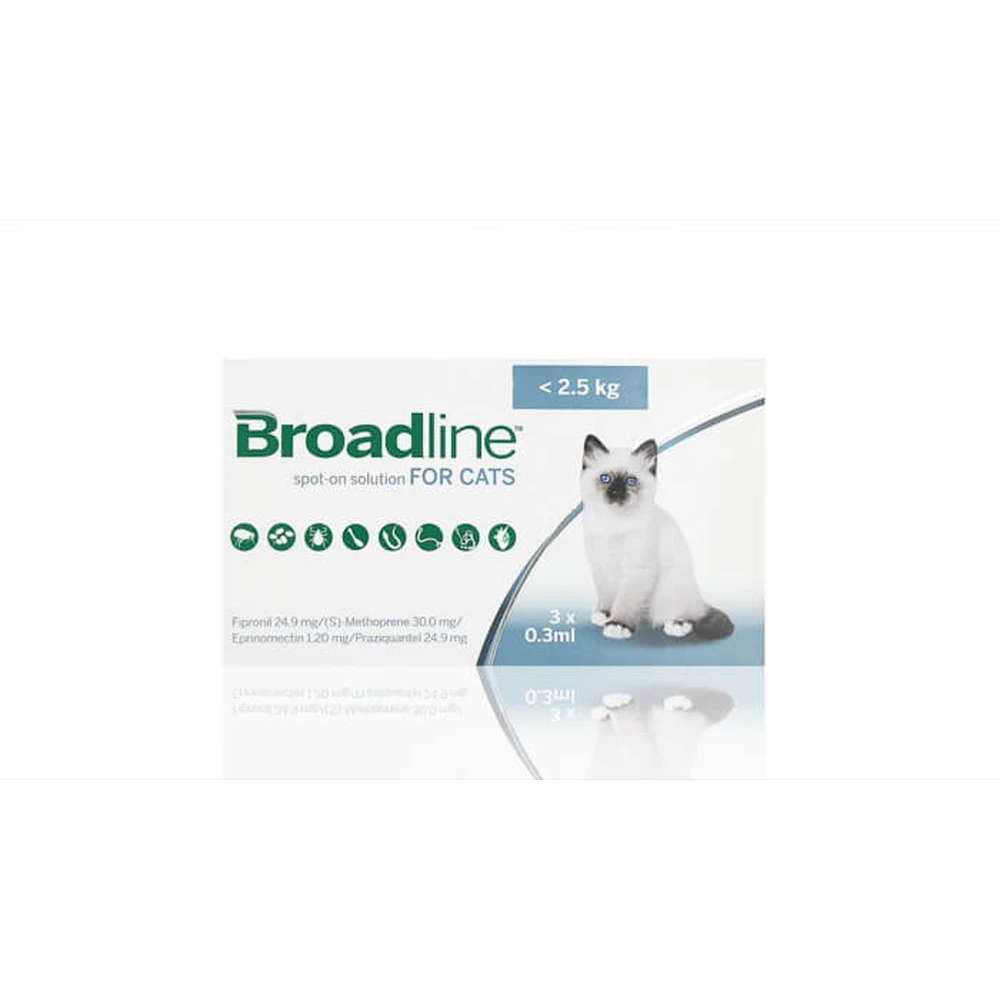
Broadline Cat S, < 2,5 kg, 3 pipetten
Beschrijving
Broadline Cat is een uitwendig antiparasitair product voor katten, dat werkzaam is tegen lintwormen, rondwormen en ectoparasieten, met effect binnen 24 uur na toepassing.
INGREDIËNTEN:
| BROADLINE perfecte oplossing | Doseringseenheid volume (ml) | Fipronil (mg) | S-methopreen (mg) | Eprinomectine (mg) | Praziquantel (mg) |
| Katten <2,5 kg | 0,3 | 24.9 | 30.0 | 1.20 | 24.9 |
| Katten van 2,5-7,5 kg | 0,9 | 74.7 | 90.0 | 3.60 | 74.7 |
Hulpstoffen:
Butylhydroxytolueen (E321) 1 mg/ml.
Voor de volledige lijst met hulpstoffen, zie paragraaf 6.1.
FARMACEUTISCHE VORM
Perfecte oplossing.
Een heldere, kleurloze of gele oplossing.
KLINISCHE BIJZONDERHEDEN
Doelsoorten
Katten.
Gebruiksaanwijzing, met vermelding van de doelsoort
Voor katten die besmet zijn met, of risico lopen op besmetting met, lintwormen en ectoparasieten. Het product is met name geschikt wanneer alle drie groepen tegelijkertijd bestreden moeten worden.
Ectoparasieten
- Behandeling en preventie van vlooienbesmettingen (Ctenocephalides felis). Elimineert vlooien binnen 24 uur na toepassing. Eén behandeling biedt bescherming tegen nieuwe besmettingen gedurende ten minste één maand.
- Voorkomt milieuverontreiniging met vlooien door de ontwikkeling van vlooien in alle ontwikkelingsstadia (eieren, larven en poppen) gedurende meer dan een maand te remmen.
- Het product kan deel uitmaken van een behandelingsstrategie ter bestrijding van vlooienallergie-dermatitis (FAD).
- Behandeling en preventie van tekenbeten (Ixodes ricinus). Elimineert teken binnen 48 uur na toepassing. Eén behandeling biedt bescherming tegen nieuwe besmettingen gedurende maximaal 3 weken.
lintwormen
- Behandeling van infestaties met platwormen (Cestodes) (Dipylidium caninum, Taenia taeniaeformis, Echinococcus multilocularis).
nematoden
- Behandeling van gastro-intestinale nematodeninfecties (L3- en L4-larven en volwassen exemplaren van Toxocara cati, L4-larven en volwassen exemplaren van Ancyclostoma tubaeforme en volwassen vormen van Toxocara leonina en Ancyclostoma brazilienze).
- Behandeling van blaasworminfecties (Capillaria plica).
- Preventie van hartwormziekte (Dirofilaria immitis-larven) gedurende één maand.
Contra-indicaties
Niet gebruiken bij zieke of herstellende dieren.
Niet geschikt voor gebruik bij konijnen.
Niet gebruiken bij overgevoeligheid voor de werkzame stoffen of een van de hulpstoffen.
Specifieke waarschuwingen voor elke doelsoort.
Bij het aanbrengen van het product moet er bij langharige rassen extra op gelet worden dat het product direct op de huid wordt aangebracht en niet in de vacht. Anders zal de biologische beschikbaarheid van het product afnemen en de effectiviteit dus verminderd zijn.
Het is van groot belang dat het diergeneesmiddel op de huid wordt aangebracht op een plek waar het dier het product niet kan oplikken. Zorg er ook voor dat de dieren elkaar na de behandeling niet likken.
Er zijn geen gegevens beschikbaar over het effect van baden/shampooën op de werkzaamheid van het product bij katten. Het is echter onwaarschijnlijk dat kortstondig contact met water, één of twee keer per maand na het aanbrengen van het product, de werkzaamheid ervan significant vermindert. Uit voorzorg wordt aanbevolen het dier gedurende 2 dagen na het aanbrengen van het product niet te baden.
Na behandeling met BROADLINE worden teken over het algemeen binnen 48 uur na de besmetting gedood zonder dat ze bloedzuigend gedrag vertonen. Het is echter mogelijk dat sommige teken op het dier achterblijven en daarom kan de overdracht van infectieziekten niet volledig worden uitgesloten.
Een plaag van platwormen kan terugkeren als tussengastheren zoals vlooien, muizen, enz. niet worden bestreden.
Resistentie van parasieten tegen een bepaalde klasse antiparasitaire geneesmiddelen kan ontstaan door frequent gebruik van een middel uit die klasse. Daarom moet rekening worden gehouden met beschikbare informatie over de huidige gevoeligheid van de doelsoort om de kans op toekomstige selectie voor resistentie te beperken.
Katten die leven in gebieden waar hartwormziekte endemisch is, of katten die naar dergelijke gebieden zijn gereisd.
Dergelijke gebieden kunnen besmet zijn met volwassen hartwormen. Hoewel het product kan worden toegediend aan katten die besmet zijn met volwassen hartwormen, is er geen therapeutisch effect tegen volwassen hartwormen van de soort Dirofilaria immitis aangetoond. Daarom wordt aanbevolen om alle katten van 6 maanden en ouder, die in gebieden wonen waar hartwormziekte endemisch is, te testen op een besmetting met volwassen hartwormen voordat het profylactische product wordt toegepast.
Speciale voorzorgsmaatregelen bij gebruik
Speciale voorzorgsmaatregelen bij gebruik bij dieren
Uitsluitend voor plaatselijke toepassing. Niet injecteren, oraal toedienen of op een andere manier toedienen. Vermijd contact met de ogen van de kat.
De veiligheid van het product is niet getest voor perioden korter dan 2 weken of bij kittens met een gewicht van minder dan 0,6 kg en/of een leeftijd van minder dan 7 weken.
Dit product is niet bedoeld voor gebruik bij honden. Bepaalde hondenrassen kunnen een verhoogde gevoeligheid hebben voor macrocyclische lactonen, die neurotoxische effecten kunnen veroorzaken. Inname door rassen zoals Collies, Engelse Herdershonden en kruisingen of verwante rassen dient daarom te worden vermeden.
Echinococcosis vormt een risico voor de mens en is een van de ziekten die worden gemonitord door de Wereldorganisatie voor Diergezondheid (OIE).
Speciale voorzorgsmaatregelen die moeten worden genomen door de persoon die het diergeneesmiddel aan dieren toedient.
Niet roken, drinken of eten tijdens het hanteren van het product.
Was uw handen grondig na gebruik.
Ongebruikte applicators dienen in de intacte blisterverpakking te worden bewaard.
Vermijd contact van de vingers met de inhoud van de applicator. Was in dat geval uw handen met water en zeep. Spoel bij contact met de ogen grondig met water, aangezien het product lichte oogirritatie kan veroorzaken. Raadpleeg een arts als de oogirritatie aanhoudt of als er bijwerkingen optreden en toon de bijsluiter of het etiket aan de arts.
Raak het dier niet aan totdat de behandelde plek droog is, en kinderen mogen gedurende deze periode niet met het dier spelen. Het is daarom raadzaam dat pas behandelde dieren niet bij hun baasjes slapen, vooral niet bij kinderen.
Personen met een bekende overgevoeligheid voor een van de werkzame stoffen of hulpstoffen mogen dit diergeneesmiddel niet hanteren.
Bijwerkingen (frequentie en ernst)
Na de behandeling kan de vacht op de behandelde plek tijdelijk plakkerig aanvoelen.
Milde en tijdelijke huidreacties kunnen optreden op de plaats waar het product wordt aangebracht (plaatselijke haaruitval, jeuk).
Als de kat na de behandeling aan zijn vacht likt, kan er tijdelijk sprake zijn van overmatige speekselproductie.
Inname van het product kan leiden tot braken en/of tijdelijke neurologische symptomen zoals ataxie, desoriëntatie, apathie en verwijde pupillen.
Al deze symptomen verdwijnen spontaan binnen 24 uur. Correct gebruik minimaliseert het optreden van deze reacties (zie paragraaf 4.9).
Te gebruiken tijdens zwangerschap, borstvoeding of het leggen van de baby.
De veiligheid van dit diergeneesmiddel tijdens dracht en lactatie is niet vastgesteld. Laboratoriumonderzoek met de afzonderlijke werkzame stoffen bij ratten en konijnen heeft geen teratogene, foetotoxische of maternotoxische effecten aangetoond. Gebruik het middel uitsluitend na een afweging van de voordelen en risico's door de dierenarts.
Interacties met andere geneesmiddelen of andere vormen van interactie.
Ze kennen elkaar niet.
Te toedienen hoeveelheden en toedieningswijze
Uiterst vlekkeloze administratie.
Het product mag alleen worden gebruikt als een gemengde besmetting is vastgesteld of als er een risico bestaat op een gemengde besmetting met ectoparasieten en nematoden (ook ter voorkoming van hartwormziekte) en wanneer gelijktijdige behandeling tegen lintwormen is geïndiceerd. Bij afwezigheid van risico op gelijktijdige besmetting wordt een breedspectrum parasiticum aanbevolen als eerste behandelingsoplossing.
De indicatie voor gebruik moet worden aangepast aan de behoeften van de kat, vastgesteld door middel van een klinische evaluatie, de levensstijl van het dier en de lokale epidemiologische situatie (inclusief zoönotische risico's indien van toepassing), zodat het middel uitsluitend wordt gebruikt in situaties van parasitaire besmetting of risico op gemengde besmetting.
Een behandeling mag niet zomaar van het ene dier op het andere worden toegepast zonder overleg met een dierenarts.
Dosering:
De minimaal aanbevolen doseringen zijn 10 mg/kg lichaamsgewicht voor fipronil, 12 mg/kg voor (S)-methopreen, 0,5 mg/kg voor eprinomectine en 10 mg/kg voor praziquantel.
Kies de juiste applicator op basis van het gewicht van de kat.
Gewicht van de kat | Volume van de toegediende eenheid (ml) | Fipronil (mg) | S-methopreen (mg) | Eprinomectine (mg) | Praziquantel (mg) |
< 2,5 kg | 0,3 | 25 | 30 | 1.2 | 25 |
2,5-7,5 kg | 0,9 | 75 | 90 | 3.6 | 75 |
7,5 kg | De juiste combinatie van applicators |
Wijze van toediening:
Knip de blisterverpakking met een schaar langs de stippellijn open en verwijder vervolgens de folie.
Haal de applicator uit de verpakking en houd hem met de punt naar boven. Trek de zuiger langzaam naar achteren, draai en verwijder de dop. Maak een opening in de vacht in het midden van de nek, tussen de schedelbasis en de schouderbladen, zodat de huid zichtbaar is. Plaats de punt van de applicator op de huid en breng de gehele inhoud direct op één plek aan.
Om hartwormziekte (Dirofilaria immitis-larven) te voorkomen, moet het product 1 maand vóór de eerste blootstelling aan muggen worden aangebracht.
Overdosering (symptomen, noodprocedures, tegengif), indien van toepassing
Veilig gebruik is aangetoond bij gezonde kittens van 7 weken of ouder die een dosis kregen tot 5 keer de maximaal verdraagbare dosis (d.w.z. tot 15 keer de aanbevolen dosis), tot 6 keer behandeld met tussenpozen van vier weken. Veilig gebruik is ook aangetoond bij gezonde volwassen katten die 3 keer behandeld werden met tussenpozen van 2 weken met een dosis tot 5 keer de aanbevolen dosis. Tijdelijke neurologische verschijnselen zoals ataxie, desoriëntatie, apathie en verwijde pupillen kunnen worden waargenomen, die meestal spontaan de volgende dag verdwijnen. In geïsoleerde gevallen kunnen ook tijdelijke speekselvloed en/of braken voorkomen bij kittens en volwassen katten.
Katten die besmet waren met volwassen hartwormen verdroegen tot 3 keer de maximaal toegestane dosis (d.w.z. tot 9 keer de aanbevolen dosis), 3 behandelingen met tussenpozen van 4 weken, zonder nadelige effecten.
Wachttijd
Dat is niet het geval.
FARMACOLOGISCHE EIGENSCHAPPEN
Farmacotherapeutische groep: antiparasitaire producten; ATC-veterinaire code: QP54AA54.
Dit diergeneesmiddel is een insecticide en acaricide oplossing voor uitwendig gebruik, die de actieve bestanddelen fipronil (adulticide) en (S)-methopreen (ovicide en larvicide) bevat in combinatie met het endectocide eprinomectine en het cestocide praziquantel, waarmee het brede spectrum wordt aangevuld met werking tegen gastro-intestinale nematoden, longwormen, platwormen en blaaswormen.
Farmacodynamische eigenschappen
Fipronil is een insecticide en acaricide dat behoort tot de fenylpyrazoolfamilie. Fipronil en zijn metaboliet, fipronilsulfon, werken in op ligand-geactiveerde chloride-ionkanalen, met name die geactiveerd worden door de neurotransmitter gamma-aminoboterzuur (GABA), en tevens door desensibilisatie (D) en niet-desensibilisatie (N) van glutamaat-geactiveerde ionkanalen (Glu, de unieke ligand-geactiveerde chloride-ionkanalen van ongewervelden). Hierdoor wordt de pre- en postsynaptische overdracht van chloride-ionen over het celmembraan geblokkeerd. Dit leidt tot ongecontroleerde activiteit van het centrale zenuwstelsel van insecten en mijten, met de dood tot gevolg.
(S)-Methopreen is een insectengroeiregulator (IGR) die behoort tot de klasse van verbindingen die bekend staan als juvenielhormoonanalogen. Deze stoffen remmen de ontwikkeling van onvolgroeide insecten. De stof bootst de werking van juvenielhormoon na en beïnvloedt de ontwikkeling van onvolgroeide vlooien, wat uiteindelijk leidt tot hun dood. De ovicide werking van (S)-methopreen in het gastdier vindt plaats door directe penetratie van de schaal van vers gelegde eieren of door absorptie via de cuticula van volwassen vlooien. (S)-Methopreen is ook effectief in het blokkeren van de ontwikkeling van vlooienlarven en -poppen, waardoor besmetting van de omgeving waarin behandelde dieren leven met onvolgroeide vlooien wordt voorkomen.
Eprinomectine behoort tot de klasse van macrocyclische lactonen, een groep endectociden. Stoffen uit deze klasse binden selectief en met hoge affiniteit aan chloride-ionkanalen in spier- en zenuwcellen. Dit leidt tot een verhoogde permeabiliteit van het celmembraan voor chloride-ionen, met hyperpolarisatie van de zenuw- of spiercellen als gevolg, wat resulteert in verlamming en de dood van de parasiet. Het werkingsspectrum van eprinomectine bij katten is aangetoond voor zowel gastro-intestinale als extra-intestinale nematoden.
Praziquantel is een synthetisch pyrazino-isoquinoline-derivaat dat werkzaam is tegen platwormen. Praziquantel wordt snel door de parasieten opgenomen en beïnvloedt de permeabiliteit van het lintwormmembraan door de flux van tweewaardige kationen te beïnvloeden, met name de homeostase van calciumionen. Dit is verantwoordelijk voor snelle spiercontractie en vacuolisatie. Dit leidt tot ernstige beschadiging van de huid van de parasiet, samentrekkingen en verlamming, verstoring van de stofwisseling en uiteindelijk de dood en loslating van de parasiet. Af en toe kunnen gedesintegreerde of gedeeltelijk verteerde fragmenten in de ontlasting worden aangetroffen.
Farmacokinetische kenmerken
De ectoparasitaire werking van fipronil en (S)-methopreen wordt bereikt door direct contact met de ectoparasieten, niet door systemische blootstelling. Na een eenmalige topische toepassing van het product werden de werkzame stoffen vanaf de eerste dag na toepassing in verschillende delen van het lichaam van de kat aangetroffen, waaronder de staartstreek. Dit duidt op verspreiding vanuit de aanbrengplaats (tussen de kop en de schouderbladen) door het hele lichaam van het dier.
Fipronilsulfon, een derivaat van fipronil, wordt ook in de vacht aangetroffen. De concentraties van fipronil, fipronilsulfon en (S)-methopreen in de vacht nemen in de loop van de tijd af, maar blijven minstens 42 dagen na toediening aantoonbaar. Topische toepassing, met mogelijke orale blootstelling door likken, resulteerde in gedeeltelijke systemische absorptie die in de loop van de tijd afnam. De piekplasmaconcentraties van de geabsorbeerde fracties van fipronil en (S)-methopreen worden na 8 tot 9 uur bereikt.
In tegenstelling tot andere diersoorten wordt fipronilsulfon niet gevormd bij katten. Fipronil wordt voornamelijk onveranderd via de ontlasting uitgescheiden. (S)-methopreen wordt, eenmaal geabsorbeerd, snel gemetaboliseerd en uitgescheiden.
Eprinomectine en praziquantel werken systemisch en bereiken respectievelijk binnen 48 en 6 uur na behandeling hun piekplasmaconcentratie, met een gemiddelde maximale concentratie (Cmax) van 20,1 ng/ml voor eprinomectine en 157 ng/ml voor praziquantel.
Praziquantel (99%) wordt zeer slecht in het bloed opgenomen en zeer goed verdeeld over de weefsels. De metabolisatie ervan is beperkt en het wordt grotendeels onveranderd via de ontlasting uitgescheiden. De gemiddelde halfwaardetijd van deze stof is 4,75 dagen. Praziquantel wordt matig verdeeld over de weefsels en bindt zich voor ongeveer 64-84% aan plasmaproteïnen. Praziquantel wordt gemetaboliseerd in de lever en vervolgens uitgescheiden door de nieren. De gemiddelde halfwaardetijd van praziquantel is 3,08 dagen.
In vitro metabolismeonderzoeken en in vivo studies hebben aangetoond dat er geen farmacodynamische en farmacokinetische interactie bestaat tussen fipronil, (S)-methopreen, eprinomectine en praziquantel.
FARMACEUTISCHE GEGEVENS
Lijst van hulpstoffen
Glycerolformal
Dinatriumedetaat (E385)
Propylgallaat (E310)
Thiodipropionzuur
Dimethylisosorbide
Gebutyleerd hydroxytolueen (E321)
onverenigbaarheid
Ze kennen elkaar niet.
Geldigheidsperiode
Houdbaarheid van het diergeneesmiddel in de verpakking zoals het voor de verkoop bestemd is: 24 maanden
Speciale voorzorgsmaatregelen voor opslag
Bewaar in de originele verpakking, beschermd tegen licht.
Bewaar de applicator in de intacte blisterverpakking.
Geopende applicators dienen direct als afval te worden weggegooid.
Aard en samenstelling van de primaire verpakking
Doseringseenheid in de vorm van een spuitapplicator (transparant gesiliconiseerd cycloolefinecopolymeer (COC)) met 0,3 ml of 0,9 ml product, afgesloten met een polymeerstop en verpakt in individuele plastic blisterverpakkingen.
Kartonnen doos met 1, 3 of 4 applicators (elk 0,3 ml)
Kartonnen doos met 1, 3, 4 of 6 applicators (elk 0,9 ml)
Niet alle verpakkingsgroottes zijn mogelijk verkrijgbaar.
Speciale voorzorgsmaatregelen voor de verwijdering van ongebruikte diergeneesmiddelen of afvalstoffen die voortkomen uit het gebruik van dergelijke producten.
Alle ongebruikte diergeneesmiddelen en afvalstoffen die voortkomen uit het gebruik van dergelijke producten, dienen te worden afgevoerd in overeenstemming met de lokale voorschriften.
Verontreinig geen meren of waterwegen met het product of de lege verpakking, vanwege het gevaar voor vissen en andere waterorganismen.
LET OP: Alleen verkrijgbaar op recept.
Productconformiteitsinformatie Productconformiteitsinformatie Productveiligheid Fabrikantinformatie Persoonsgegevens ProductveiligheidsinformatieMomenteel is er geen informatie beschikbaar over de veiligheid van dit product.
FabrikantinformatieMomenteel is er geen informatie over de fabrikant beschikbaar.
Informatie over de verantwoordelijke persoonMomenteel is er geen informatie beschikbaar over de verantwoordelijke persoon.
Leeftijd: Volwassene
Presentatievorm: Pipet
Werking: Vlooien, luizen, vlooienlarven
Set van 3 stuks
Gewicht van de kat: Nee
Merknaam: Merial
\NAantal: 3 pipetten
Eigenschappen
| Productcode | 564833 |
| Categorie | Uitwendige antiparasitaire middelen voor dieren, Dierenverzorging |
| Productlijn | Broadline Cat |
| Merk | Merial |
| Hoeveelheid | 3 |
| Producttype | Pipette |
| Levering vanaf | Roemenië |
Broadline Cat S, < 2,5 kg, 3 pipetten
Broadline Cat S, < 2,5 kg, 3 pipetten
Levering vanaf Roemenië


Laat uw e-mailadres achter, dan informeren wij u zodra het product weer op voorraad is!
Recent bekeken producten


Vergelijkbare producten
Verdere producten
Productbeoordelingen

Broadline Cat S, < 2,5 kg, 3 pipetten
 Verdien £1 Bonus voor elke beoordeling
- Voor elke ingediende en goedgekeurde recensie kunt u £1 Bonus verdienen op uw Beloningskrediet.
- Beloningen worden één keer toegekend voor elk product dat u heeft beoordeeld.
- U moet geautoriseerd zijn om Beloningen te ontvangen.
Alle beoordelingen

Er zijn geen beoordelingen voor dit product.










Bestsellers

 Doppelherz System Kollagen 11.000 Plus, 30 injectieflacons x 25 ml, Queisser Pharma
 Beschrijving