Promocode APP3 – £3 korting op uw eerste bestelling in de app
  Gratis levering voor bestellingen boven £49


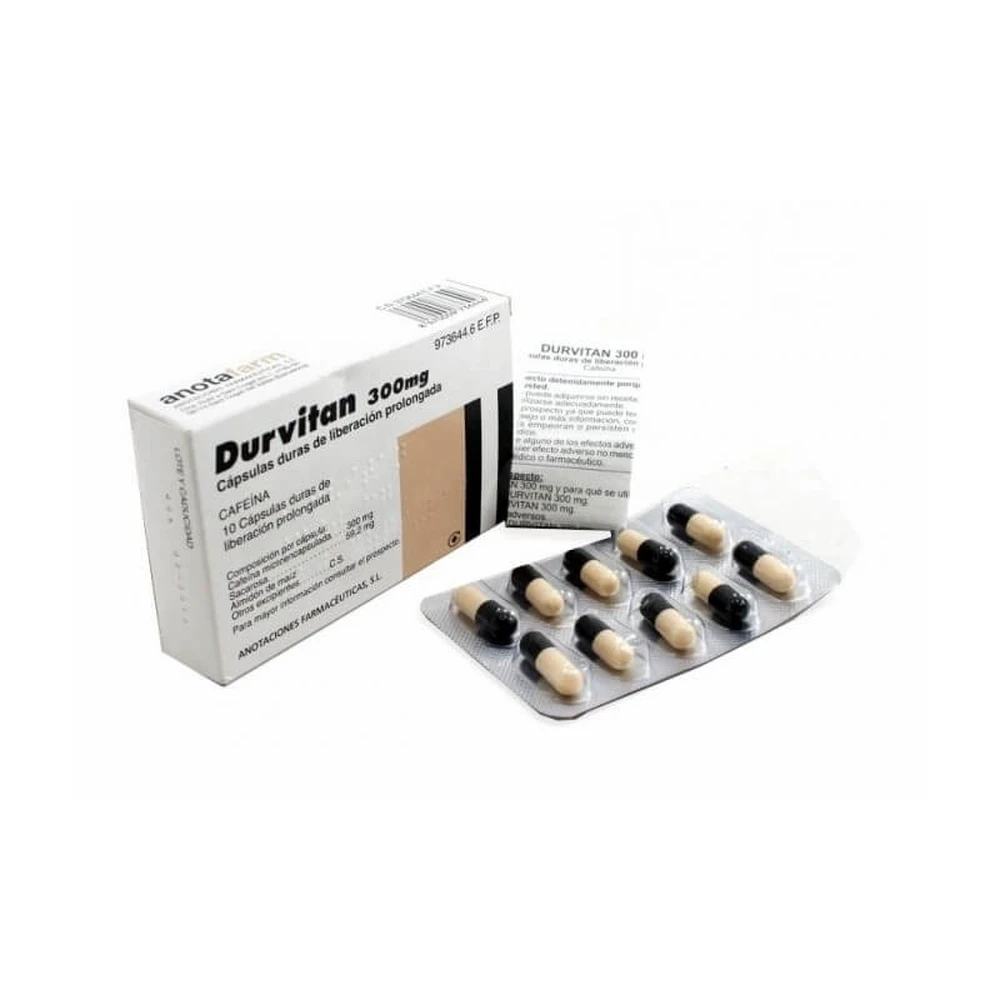
DURVITAN RETARD 300 MG 10 CAPSULES VERLENGDE AFGIFTE
Beschrijving
ACTIE EN MECHANISME
Xanthinebasis. Stimulerend middel voor het centrale zenuwstelsel. Het werkingsmechanisme berust op de remming van het fosfodiesterase-enzym, wat resulteert in een toename van cAMP; bij lage doses domineert een ander mechanisme: het antagoniseert adenosinereceptoren. Het veroorzaakt hartstimulatie (positief inotroop effect) en een verlaging van de perifere arteriolaire weerstand, wat de effecten op de bloeddruk compenseert. In de hersenen veroorzaakt het vasoconstrictie, wat heeft geleid tot de suggestie voor gebruik als middel tegen migraine. Het stimuleert de skeletspieren en het ademhalingscentrum, en verhoogt de maagzuursecretie en diurese.
SPECIALE WAARSCHUWINGEN
- Het abrupt stoppen met de regelmatige toediening van doses hoger dan 600 mg/dag kan hoofdpijn, angst en spierspasmen veroorzaken.
SENIOREN
De veiligheid en werkzaamheid van dit geneesmiddel bij ouderen zijn nog niet volledig vastgesteld. Hoewel er in deze leeftijdsgroep geen specifieke ernstige problemen worden verwacht, kunnen deze patiënten gevoeliger zijn voor bijwerkingen op het centrale zenuwstelsel. Wees voorzichtig met het gebruik.
SAMENSTELLING
Per capsule: Cafeïne, 300 mg.
PATIËNTENADVIES
- Neem de laatste dosis niet binnen 6 uur voor het slapengaan in om mogelijke slapeloosheid te voorkomen. - Slik de capsules in hun geheel door, zonder ze te kauwen of te pletten. - Neem niet meer dan 3 capsules per dag. - Als de symptomen verergeren of na 7 dagen aanhouden, wordt uw klinische situatie beoordeeld.
CONTRA-INDICATIES
- Cafeïneallergie of [xanthineallergie].- Ernstige hart- en vaatziekten ([hartritmestoornissen], [hartfalen], [coronaire insufficiëntie]): vanwege het risico op tachycardie en extrasystolen.- [epilepsie]: verhoogt het risico op epileptische aanvallen.- [slapeloosheid]: vanwege de stimulerende werking op het centrale zenuwstelsel.- [maagzweer]: vanwege het verhogende effect op de maagzuurproductie.
ZWANGERSCHAP
FDA-zwangerschapscategorie C. Dierstudies met doses equivalent aan 12-14 koppen koffie per dag gedurende de zwangerschap of zeer grote eenmalige doses hebben teratogene effecten aangetoond; lagere doses zijn in verband gebracht met vertragingen in de skeletontwikkeling. Cafeïne passeert de placenta en bereikt foetale serum- en weefselconcentraties die vergelijkbaar zijn met die van de moeder. De veiligheid van cafeïnegebruik tijdens de zwangerschap is niet vastgesteld. Overmatige cafeïneconsumptie is zwak in verband gebracht met een verhoogde kans op miskraam, een laag geboortegewicht en vroeggeboorte, hoewel een duidelijk causaal verband niet is vastgesteld. Matig gebruik lijkt echter niet in verband te staan met deze effecten of met aangeboren afwijkingen. Zwangere vrouwen wordt geadviseerd om voedingsmiddelen, dranken en medicijnen die cafeïne bevatten te beperken of te vermijden.
FARMACOKINETIEK
* Orale toediening: - Absorptie: Wordt snel geabsorbeerd (Tmax = 50-75 min). - Distributie: Wordt snel door het hele lichaam verdeeld. Plasmaproteïnebinding: 15-30%. - Metabolisme: Vrijwel volledig hepatisch via oxidatie, demethylering en acetylering. - Eliminatie: Wordt uitgescheiden in de urine, <1% onveranderd. De eliminatiehalfwaardetijd (t1/2) is 3-6 uur (volwassenen), 80-100 uur (pasgeborenen), 4-5 uur (leverfunctiestoornis); deze neemt af bij rokers en sporters en verandert niet bij ouderen of tijdens de zwangerschap.
INDICATIES
- [ASTHENIE]. Symptomatische en incidentele verlichting van voorbijgaande toestanden van asthenie.
INTERACTIES
- Orale anticonceptiva (oestrogenen): Studies hebben een verminderde cafeïneklaring aangetoond, met mogelijk een versterking van de effecten en/of toxiciteit, als gevolg van remming van het metabolisme in de lever. - Cimetidine: Studies hebben een verminderde cafeïneklaring aangetoond, met mogelijk een versterking van de effecten en/of toxiciteit, als gevolg van remming van het metabolisme in de lever. - Clozapine: Sommige studies hebben een remming van het antipsychotische effect van clozapine aangetoond, als gevolg van antagonisme van de werking ervan op dopaminereceptoren. - Disulfiram: Sommige studies hebben een verminderde cafeïneklaring aangetoond, met mogelijk een versterking van de effecten en/of toxiciteit, als gevolg van mogelijke remming van het metabolisme in de lever. - Methoxsalen: Sommige studies hebben een verminderde cafeïneklaring aangetoond, met mogelijk een versterking van de effecten en/of toxiciteit, als gevolg van remming van het metabolisme in de lever. - Mexiletine: Studies hebben een verminderde cafeïneklaring aangetoond, met mogelijk een versterking van de werking en/of toxiciteit. - Chinolonen (pipemidinezuur, ciprofloxacine, enoxacine): studies hebben een toename van de cafeïnespiegel in het plasma aangetoond, met een mogelijke versterking van de werking en/of toxiciteit, als gevolg van remming van het metabolisme in de lever.
LACTATIE
Cafeïne wordt in kleine hoeveelheden uitgescheiden in de moedermelk (melk/plasma-ratio van 0,5) en kan zich ophopen bij de baby. Wanneer een borstvoedende moeder 6-8 kopjes cafeïnehoudende dranken per dag drinkt, kan de baby symptomen van cafeïne-stimulatie vertonen (hyperactiviteit en alertheid). Het wordt aanbevolen dat borstvoedende moeders hun inname van cafeïnehoudende dranken beperken tot 1-2 kopjes per dag of minder en geen cafeïnecapsules of -tabletten gebruiken. Combinaties van pijnstillers met cafeïne, in de aanbevolen doseringen, leiden tot verwaarloosbare concentraties bij de baby.
KINDEREN
De veiligheid en werkzaamheid van dit geneesmiddel bij kinderen jonger dan 12 jaar zijn niet vastgesteld. Bijwerkingen aan het centrale zenuwstelsel (CZS) zijn over het algemeen ernstiger bij kinderen dan bij volwassenen. Gebruik wordt afgeraden bij kinderen jonger dan 12 jaar.
RICHTLIJNEN VOOR EEN JUISTE TOEDIENING
* Oraal gebruik: Neem de capsules in hun geheel door en zorg ervoor dat u de laatste dosis 6 uur voor het slapengaan inneemt om mogelijke slapeloosheid te voorkomen.
POSOLOGIE
* Asthenie: - Volwassenen en kinderen ouder dan 12 jaar, oraal: 300 mg in één of meerdere doses. Maximale dosis: 900 mg/24 uur. Indien de symptomen verergeren of langer dan 7 dagen aanhouden, dient de klinische situatie te worden geëvalueerd. - Kinderen jonger dan 12 jaar: niet gebruiken.
VOORZORGSMAATREGELEN
- [DIABETES]: Kan een verhoging van de bloedglucosespiegel veroorzaken. - [HOGE BLOEDDRUK]: De bloeddruk moet worden gecontroleerd vanwege de mogelijkheid van een verhoging. - [LEVERINSUPFICIËNTIE]: Aangezien het voornamelijk in de lever wordt gemetaboliseerd, moet de dosering worden aangepast aan de mate van leverfunctie.
VOORZORGSMAATREGELEN MET BETREKKING TOT HULPMIDDELEN
Dit geneesmiddel bevat sucrose. Patiënten met erfelijke fructose-intolerantie, glucose-galactosemalabsorptie of sucrase-isomaltasedeficiëntie mogen dit geneesmiddel niet gebruiken.
BIJWERKINGEN
De bijwerkingen van cafeïne komen over het algemeen vaak voor, hoewel ze mild en van voorbijgaande aard zijn. In de meeste gevallen zijn de bijwerkingen een gevolg van de farmacologische werking en treffen ze voornamelijk het centrale zenuwstelsel. De meest kenmerkende bijwerkingen zijn:
- Vaak (10-25%): [slapeloosheid], [onrust] en [prikkelbaarheid].
- Incidenteel (1-9%): [misselijkheid], [braken], [diarree], [maagpijn], [hoofdpijn], [tinnitus], [desoriëntatie], [extrasystolen], [hartkloppingen], [tachycardie], [hartritmestoornissen], [prikkelbaarheid], [opvliegers], [tachypneu], [polyurie]; bij hoge doses: episodes van [angst].
De behandeling moet onmiddellijk worden stopgezet als de patiënt last krijgt van duizeligheid of hartkloppingen.
SAMENSTELLING
CAFEÏNE: 300 MILLIGRAM
SUCROSE (HULPSTOF): 59,2 MILLIGRAM
Eigenschappen
| Productcode | 586136 |
| Categorie | Tegen vermoeidheid, Zenuwstelsel, Producten uit heel Europa, Produits d'Espagne |
| Hoeveelheid | 10 |
| Dosis | 300 mg |
| Producttype | Capsules |
| Levering vanaf | Spanje |
DURVITAN RETARD 300 MG 10 CAPSULES VERLENGDE AFGIFTE
DURVITAN RETARD 300 MG 10 CAPSULES VERLENGDE AFGIFTE
Levering vanaf Spanje

 1 - 3 Okt

 Gegarandeerde levering uit Spanje: 1 - 3 Oktober
-
£13.40Verzendkosten: £5.99 (gratis vanaf £49)
Levering vanaf Spanje:
1 - 3 Oktober
-
 Betaal veilig met de betaalmethode van uw keuze













Recent bekeken producten

Vergelijkbare producten
Verdere producten













 Magnesium forte 375 mg + B6, 50 filmomhulde tabletten, Beres Pharmaceuticals Co





Productbeoordelingen

DURVITAN RETARD 300 MG 10 CAPSULES VERLENGDE AFGIFTE
 Verdien £1 Bonus voor elke beoordeling
- Voor elke ingediende en goedgekeurde recensie kunt u £1 Bonus verdienen op uw Beloningskrediet.
- Beloningen worden één keer toegekend voor elk product dat u heeft beoordeeld.
- U moet geautoriseerd zijn om Beloningen te ontvangen.
Alle beoordelingen

Er zijn geen beoordelingen voor dit product.






















 Beschrijving