Código promocional APP3 - £3 de descuento en su primer pedido en la app
  Envío gratuito para pedidos superiores a £49


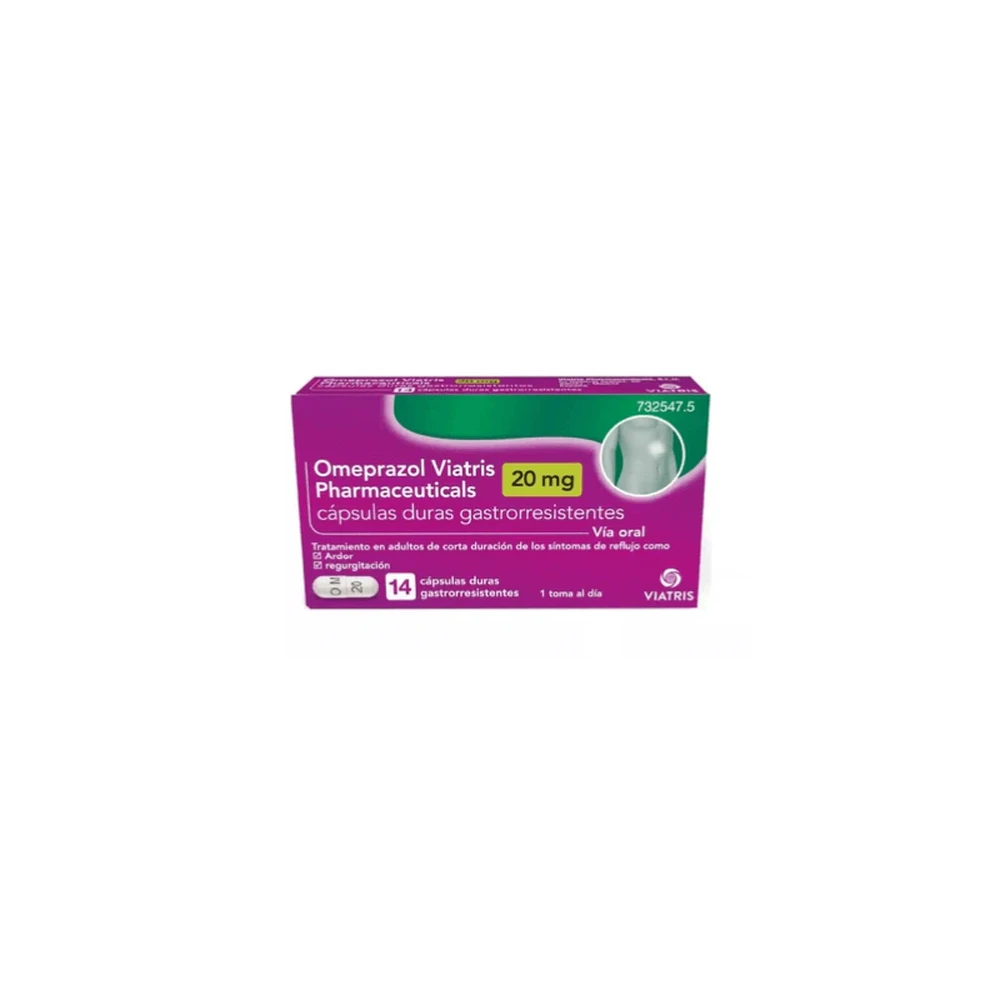
OMEPRAZOL VIATRIS 20 MG 14 CAP GASTRORRESISTENTES
Descripción
- Antiúlcera péptica, inhibidor de la bomba de H+/K+. El omeprazol es un benzimidazol que actúa como inhibidor específico, no competitivo e irreversible de la bomba de protones (IBP) o ATPasa H+/K+, localizada en la superficie de la célula parietal gástrica. El bloqueo de dicha bomba de protones impide la producción de ácido gástrico, tanto basal como ante un estímulo, independientemente de cuál sea este (acetilcolina, gastrina o histamina).
El omeprazol es una mezcla racémica de dos estereoisómeros, el S-omeprazol (esomeprazol, farmacológicamente activo) y el R-omeprazol (sin actividad sobre la producción de ácido).
Omeprazol es un profármaco con naturaleza de base débil, que tras su absorción es distribuido por el organismo, y en especial en la luz de los canalículos secretores de la célula parietal. Aquí, y en presencia de medio ácido, sufre una reacción química no enzimática dando lugar a la forma activa, un derivado sulfonamido totalmente hidrófilo, que tiende a acumularse en los canalículos y unirse a la bomba de protones mediante puentes disulfuro con los residuos de cisteína de la cadena alfa-luminal.
Debido a la formación de enlaces covalentes, la única forma que tiene la célula parietal de recuperar su actividad secretora es la síntesis de nuevas bombas, lo que supone un gran período de tiempo y explica la larga duración de los efectos de los IBP, que pueden llegar a durar hasta 4 días tras la administración de una dosis única, y a pesar de sus bajas t1/2.
La administración de una dosis de omeprazol de 20 mg dio lugar a una reducción de la secreción ácida inducida por pentagastrina del 70% a las 24 h de la administración.
Los efectos sobre la producción ácida comienzan a aparecer al cabo de 2 h, si bien pueden requerirse hasta 5 días para alcanzarse la actividad antiulcerosa máxima. Sus efectos pueden ser prolongados, y en algunos estudios se ha observado una inhibición de la secreción ácida del 26% (20 mg) y 48% (mg) a las 24 h de la administración.
ADVERTENCIAS ESPECIALES
- Se recomienda confirmar la curación de las ulceraciones mediante endoscopia antes de suspender el tratamiento.
- Los IBP podrían enmascarar los síntomas de tumores digestivos de esófago o estómago. Se recomienda vigilar estrechamente a los pacientes tratados con un IBP durante periodos prolongados, superiores a 1 año. Si el paciente experimenta síntomas como pérdida de peso importante e injustificada, vómitos frecuentes, disfagia, hematemesis o melena, se recomienda realizar un diagnóstico diferencial.
- En caso de aparición de diarrea grave y prolongada se investigará la posible infección por Clostridium difficile.
- El tratamiento con IBP durante un periodo prolongado ha dado lugar raramente a cuadros graves de hipomagnesemia, que podría asociarse a hipocalcemia. Si el paciente experimenta síntomas como astenia, mareo, tetania, convulsiones o arritmia cardiaca se determinarán los niveles de magnesio, y en caso de hipomagnesemia se suspenderá el tratamiento y se administrará un suplemento de magnesio.
- Los antiulcerosos podrían interferir en el diagnóstico de tumores neuroendocrinos, al incrementar los niveles del marcador específico cromogranina A (CgA), dando lugar a falsos negativos. Suspender el antiulceroso al menos 5 días antes de la prueba, y si no se hubieran normalizado sus niveles, repetir la prueba a los 14 días de la suspensión.
- Monitorización:
* Niveles de magnesio a nivel basal y periódicamente en pacientes tratados durante largos periodos con omeprazol, tratados con digoxina o con fármacos que pudieran dar lugar a hipomagnesemia, como diuréticos.
CONSEJOS AL PACIENTE
- No suspenda el tratamiento hasta que así lo indique su médico, aunque los síntomas hayan desaparecido. Una suspensión prematura podría hacer que los síntomas reapareciesen.
- Avise a su médico acerca de los medicamentos que esté tomando.
- Informe a su médico y/o farmacéutico si presenta alguno de estos síntomas:
* Diarrea intensa y/o persistente.
* Pérdida de peso importante e injustificada, vómitos frecuentes, dificultad para tragar o presencia de sangre en vómitos o heces.
* Cansancio injustificado, mareo, rigidez muscular, convulsiones o arritmias cardiacas.
* Aparición de lesiones en la piel, especialmente en zonas expuestas al sol, acompañadas de dolor articular.
CONTRAINDICACIONES
- Hipersensibilidad a omeprazol, a cualquier otro IBP, o a cualquier otro componente del medicamento.
- Tratamiento conjunto con nelfinavir (véase Interacciones – Inhibidores de la proteasa).
FARMACOCINÉTICA
El omeprazol es un profármaco, y tras su absorción y distribución a la célula parietal, se transforma por una reacción química catalizada en medio ácido en el derivado sulfonamido activo.
INDICACIONES
- Tratamiento a corto plazo de los síntomas del [REFLUJO GASTROESOFAGICO], como [HIPERACIDEZ GASTRICA] o regurgitación ácida en adultos.
INTERACCIONES
- Anticoagulantes orales. Se han descrito casos de aumentos del INR en pacientes tratados con un anticoagulante y un IBP. Se recomienda usar con precaución, monitorizando el INR.
- Clopidogrel. El omeprazol a altas dosis podría disminuir el efecto de clopidogrel, al inhibir la transformación a su metabolito activo, mediada por CYP2C19 (aunque podría existir algún otro mecanismo ya que clopidogrel tiene varias rutas metabólicas). Se recomienda evitar la asociación entre omeprazol y clopidogrel. Pantoprazol, y en menor medida lansoprazol y rabeprazol, podrían ser alternativas más seguras.
- Disulfiram. Se ha descrito un caso de reacción catatónica al combinar con omeprazol.
- Fármacos con absorción dependiente de pH. El incremento del pH producido por los antiulcerosos podría modificar la absorción de determinados medicamentos, al favorecer o reducir su disolución en el medio acuoso del contenido gástrico. De tal manera se ha observado un incremento en la absorción de digoxina, así como una reducción en la de antifúngicos azólicos (itraconazol, ketoconazol, posaconazol), micofenolato mofetilo, rilpivirina, vitamina B12 e inhibidores de la tirosina-kinasa (dasatinib, erlotinib, gefitinib, lapatinib, nilotinib, pazopanib).
Es rara la aparición de toxicidad por digoxina, pero ante sus graves efectos se aconseja precaución en pacientes ancianos tratados con altas dosis. Se recomienda monitorizar los niveles plasmáticos de digoxina.
- Inductores/inhibidores enzimáticos. Omeprazol se metaboliza por CYP2C19 y en menor medida por CYP3A4, por lo que sus niveles plasmáticos podrían modificarse por inhibidores potentes (fluconazol, fluvoxamina, ticlopidina) o inductores (rifampicina) de ambos isoenzimas. También existen ciertos riesgos con fármacos que afecten a un solo isoenzima, especialmente al CYP2C19, que es el mayoritario. No se considera necesario un reajuste posológico, ya que el efecto sería como el observado en metabolizadores lentos, pero podría ser más importante en caso de insuficiencia hepática grave y tratamiento a largo plazo.
- Inhibidores de la proteasa (IP). Los IBP podrían alterar los niveles plasmáticos de determinados IP, bien por el incremento del pH o por la inhibición del CYP2C19.
Se han descrito reducciones importantes en los niveles plasmáticos de nelfinavir y de atazanavir. La administración conjunta con nelfinavir está contraindicada, y no se aconseja combinar con atazanavir. Si no fuera posible evitar esta asociación, se recomienda aumentar la dosis de atazanavir de 300 a 400 mg, aunque este incremento de dosis no contrarrestó totalmente el efecto sobre los niveles plasmáticos del atazanavir, por lo que se debe evaluar la respuesta en el paciente.
Se ha descrito un incremento en los niveles de saquinavir de hasta el doble.
Finalmente no se han observado alteraciones farmacocinéticas importantes al combinar con amprenavir, darunavir, fosamprenavir, lopinavir o tipranavir.
- Metotrexato. Los IBP podrían aumentar los niveles séricos de metotrexato.
- Sustratos de CYP2C19. Omeprazol es inhibidor moderado del CYP2C19, por lo que podría incrementar los niveles plasmáticos de fármacos que se metabolicen por este sistema, como ciertos antidepresivos tricíclicos (clomipramina, imipramina), cilostazol, citalopram, diazepam, fenitoína, voriconazol o warfarina. Podría ser necesario reducir las dosis de estos fármacos, especialmente en caso de tratamientos a demanda con IBP.
En el caso de fenitoína y warfarina sería aconsejable además monitorizar sus niveles plasmáticos al iniciar y finalizar un tratamiento con omeprazol.
- Tacrolimus. Se ha notificado un aumento de los niveles séricos de tacrolimus al administrar con omeprazol.
No se han encontrado interacciones farmacológicas al asociar a antiácidos, beta-bloqueantes (metoprolol, propranolol) domperidona, fluoroquinolonas o teofilina.
NORMAS PARA LA CORRECTA ADMINISTRACIÓN
- Cápsulas gastrorresistentes: ingerir enteras con ayuda de medio vaso de líquido. No deben masticarse, triturarse ni partirse.
Si el paciente experimenta dificultad para tragar las cápsulas, se pueden abrir y succionar o suspender su contenido en medio vaso de agua sin gas, zumo de fruta o alimentos blandos como yogur o compota de manzana. La suspensión con los gránulos debe beberse inmediatamente o en el plazo de 30 min. A continuación, llenar el vaso hasta la mitad con agua y apurar el contenido. Los gránulos no deben masticarse ni triturarse.
Administración con alimentos: administrar preferiblemente en ayunas, a primera hora de la mañana.
POSOLOGÍA EN INSUFICIENCIA HEPÁTICA
Normalmente basta una dosis de 10-20 mg/24 h.
POSOLOGÍA EN INSUFICIENCIA RENAL
No requiere reajuste posológico.
PRECAUCIONES
- [INSUFICIENCIA HEPATICA]. La insuficiencia hepática podría incrementar la exposición, por reducción del efecto de primer paso hepático, y disminuir la eliminación por reducción del metabolismo. No obstante, se ha comprobado que omeprazol no tiende a acumularse en estos pacientes cuando se administra una vez al día. Se aconseja usar con precaución. Los pacientes con insuficiencia hepática podrían requerir una menor dosis de mantenimiento.
- [INFECCIONES DIGESTIVAS]. El incremento del pH gástrico producido por los antiulcerosos podrían favorecer la colonización del aparato digestivo por determinados microorganismos patógenos, como Salmonella, Campylobacter e incluso Clostridium difficile en pacientes hospitalizados. Se recomienda realizar un diagnóstico diferencial de [COLITIS PSEUDOMEMBRANOSA] en pacientes tratados con un antiulceroso en los que aparezca diarrea grave.
- [DEFICIT DE CIANOCOBALAMINA]. El aumento del pH producido por los fármacos antiulcerosos podría disminuir la absorción de la cianocobalamina, por lo que se recomienda tenerlo en cuenta en personas con bajos depósitos de esta vitamina, como en pacientes con [DESNUTRICION] o dietas vegetarianas estrictas sin suplementación es esta vitamina, o situaciones en las que podría verse reducida su absorción, como en [ALCOHOLISMO CRONICO], [MALABSORCION INTESTINAL] o situaciones que pudieran dar lugar a malabsorción, como [ENFERMEDAD INFLAMATORIA INTESTINAL] o procesos quirúrgicos mayores del aparato digestivo.
- [HIPOMAGNESEMIA]. El tratamiento con IBP se ha relacionado con la aparición de casos graves de hipomagnesemia, que podrían asociarse a [HIPOCALCEMIA]. Su frecuencia no se ha estimado, pero se considera rara. No obstante, se debe tener en cuenta la gran utilización de estos fármacos, por lo que su impacto clínico podría ser importante. La mayoría de los pacientes que presentaron hipomagnesemia estaban en tratamiento a largo plazo (al menos 3 meses y fundamentalmente 1 año).
Se recomienda monitorizar los niveles de magnesio al inicio del tratamiento y periódicamente a lo largo del mismo en pacientes en tratamiento a largo plazo con IBP, en tratamiento con digoxina o con fármacos que pudieran dar lugar a hipomagnesemia, como los diuréticos.
En caso de aparición de síntomas de hipomagnesemia, como cansancio, mareo, tetania, delirio, convulsiones o arritmia cardiaca se determinarán los niveles de magnesio. La hipomagnesemia responde a la eliminación del IBP y la administración de suplementos de magnesio.
- [OSTEOPOROSIS]. La administración de IBP a altas dosis y durante periodos prolongados de tiempo (> 1 año) se ha relacionado con un incremento del riesgo de fractura de cadera, muñeca y vertebral, especialmente en personas de edad avanzada y con factores de riesgo. Se aconseja por tanto que las mujeres con osteoporosis reciban un tratamiento y un aporte adecuado de calcio y vitamina D.
- [NEUMONIA]. El tratamiento con IBP se ha relacionado con casos de neumonía, incluyendo neumonía adquirida en la comunidad (CAP), neumonía intersticial o neumonía nosocomial. El riesgo parece ser mayor en pacientes que acaban de iniciar un tratamiento (especialmente < 2 días), más que en tratamientos de larga duración.
- [LUPUS ERITEMATOSO CUTANEO SUBAGUDO] (LECS). Los IBP se han relacionado con casos muy raros de lupus eritematoso cutáneo subagudo. En caso de aparición de lesiones en la piel, especialmente en zonas expuestas al sol, acompañadas de artralgia, considerar la interrupción del tratamiento. Los pacientes con LECS por un IBP pueden volver a experimentar este cuadro si reciben otro IBP diferente.
- Interferencias analíticas. El incremento del pH gástrico inducido por los antiulcerosos pueden incrementar los niveles plasmáticos de gastrina (que suelen volver al nivel basal a las 4 semanas de suspender el tratamiento) y de cromogranina A (CgA).
La CgA es marcador específico de tumores neuroendocrinos, por lo que los antiulcerosos podrían dar lugar a falsos positivos cuando se utilice este marcador en las pruebas diagnósticas. Por tanto, debe suspenderse cualquier antiulceroso al menos 5 días antes de la determinación de CgA. Si los niveles de CgA no se han normalizado en este periodo, la prueba deberá repetirse 14 días después de la suspensión del antiulceroso.
- Tratamiento a largo plazo. Los antiulcerosos eliminan los síntomas relacionados con las enfermedades del ácido, que son comunes a los de procesos malignos como [CANCER DE ESTOMAGO] o [CANCER DE ESOFAGO]. Por tanto, existe el riesgo de retrasar el diagnóstico de estos procesos.
Se recomienda que los pacientes que reciban un tratamiento prolongado, superior a un año, sean sometidos a una vigilancia regular, y que se les advierta que notifiquen la presencia de otros síntomas asociados a estas neoplasias, como pérdida de peso importante e injustificada, vómitos recurrentes, disfagia o vómitos en sangre o heces. En caso de sospecha de algún proceso digestivo grave se recomienda realizar un diagnóstico diferencial.
- Deterioro renal: Se ha observado [NEFRITIS TUBULOINTERSTICIAL AGUDA] en pacientes que tomaban omeprazol y puede aparecer en cualquier momento durante el tratamiento con omeprazol (ver sección 4.8). La nefritis tubulointersticial aguda puede evolucionar a insuficiencia renal.
- Se han notificado como raras o muy raras la aparición de reacciones cutáneas como [NECROLISIS EPIDERMICA TOXICA] o [SINDROME DE STEVENS-JOHNSON], que pueden ser mortales o potencialmente mortales.
PRECAUCIONES RELATIVAS A EXCIPIENTES
- Este medicamento contiene sacarosa. Los pacientes con [INTOLERANCIA A FRUCTOSA] hereditaria, malaabsorción de glucosa o galactosa, o insuficiencia de sacarasa-isomaltasa, no deben tomar este medicamento.
Características
| Código del producto | 585631 |
| Categoría | Suministros médicos, Suministros médico-técnicos y médicos, Kits útiles, Productos de toda Europa, Productos de España |
| Marca | Viatris |
| Cantidad | 14 |
| Dosis | 20 mg |
| Tipo de producto | Cápsulas |
| Entrega desde | España |
OMEPRAZOL VIATRIS 20 MG 14 CAP GASTRORRESISTENTES
OMEPRAZOL VIATRIS 20 MG 14 CAP GASTRORRESISTENTES
Entrega desde España

 6 - 15 Oct

 Entrega garantizada desde España: 6 - 15 Octubre
-
£5.80Gastos de envío: £5.99 (gratis a partir de £49)
Entrega desde España:
6 - 15 Octubre
-
 Paga de forma segura con tu método de pago preferido













Productos vistos recientemente
















Reseñas

OMEPRAZOL VIATRIS 20 MG 14 CAP GASTRORRESISTENTES
 Consiga £1 de Recompensa por cada opinión
- Por cada reseña enviada y aprobada, puede conseguir £1 de Recompensa en su Crédito de Recompensas.
- Las recompensas se conceden una vez por cada producto comprado que haya valorado.
- Debe estar autorizado para poder recibir Recompensas.
Todas las reseñas

No hay comentarios para este producto











 Descripción