Código promocional APP3 - £3 de descuento en su primer pedido en la app
  Envío gratuito para pedidos superiores a £49


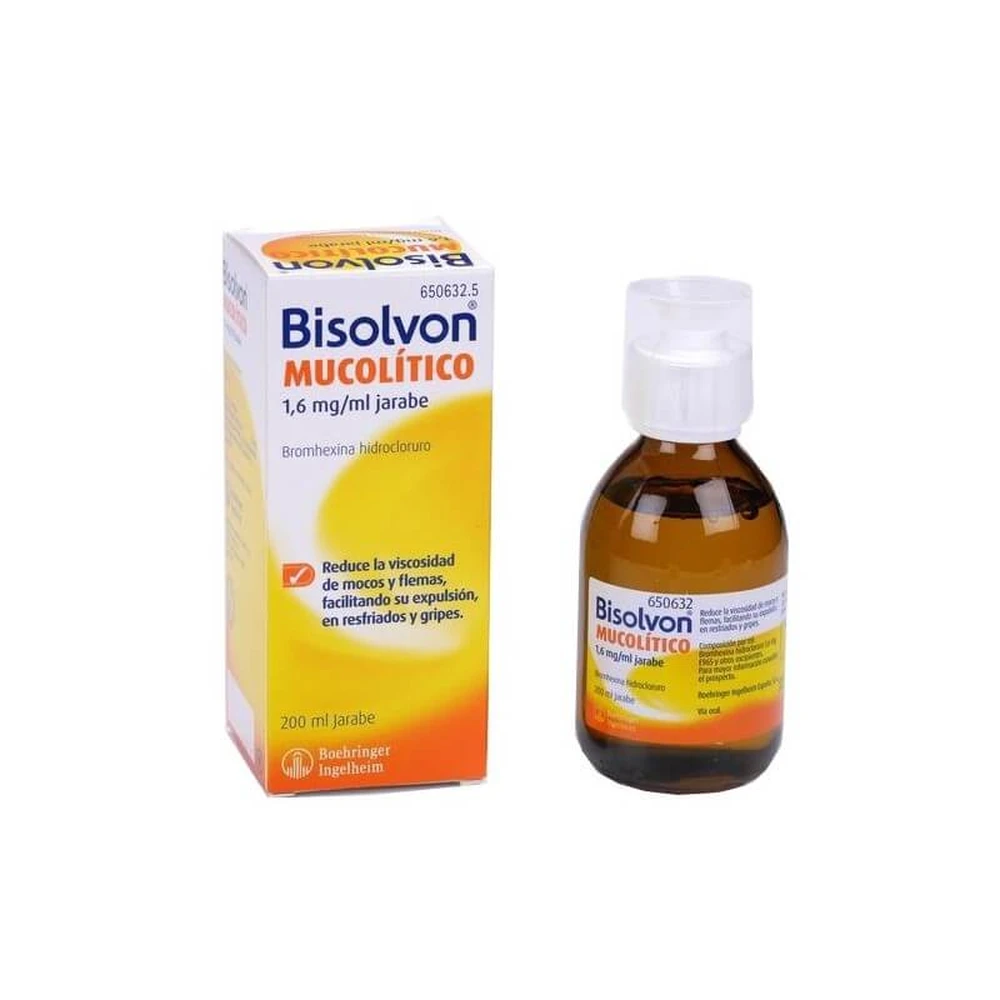
BISOLVON MUCOLITICO 1.6 MG/ML JARABE 200 ML
Descripción
ACCIÓN Y MECANISMO
- Mucolítico, expectorante. La bromhexina es un derivado bromado del alcaloide vasicina, presente en el haba de Malabar (Adhatoda vasica), empleada tradicionalmente como antiasmática. La bromhexina disminuye la viscosidad de las secreciones bronquiales e incrementa su volumen, a la vez que favorece su expulsión. Se desconoce su mecanismo de acción, aunque parece activar a la sialil-transferasa, encargada de sintetizar sialomucinas. El aumento de la síntesis de dichas proteínas restablece el equilibrio a la producción del moco bronquial. Además podría estimular las glándulas mucosas del epitelio bronquial, aumentar los niveles de lisozima, que produciría la ruptura de los mucopolisacáridos, y estimular la actividad mucociliar.
ADVERTENCIAS ESPECIALES
- El uso de mucolíticos y expectorantes en niños menores de 2 años está contraindicado como consecuencia del riesgo de obstrucción bronquial.
- En caso de aparición de erupciones cutáneas en piel o mucosas, se suspenderá la bromhexina y se evaluará la posibilidad de cuadros como la necrolisis epidérmica tóxica o el síndrome de Stevens-Johnson.
ANCIANOS
No se han descrito problemas específicos en este grupo de edad. Uso aceptado.
CONSEJOS AL PACIENTE
- Beber abundante cantidad de agua durante el tratamiento.
- No utilice antitusivos durante la utilización de bromhexina.
- Consultar con el médico y/o farmacéutico si los síntomas empeoran o no mejoran en 5 días, o si aparece fiebre, dolor de cabeza o de garganta.
- Informe a su médico y/o farmacéutico si aparecen durante el tratamiento erupciones en la piel, en ocasiones asociadas a aparición de ampollas o lesiones en las mucosas.
CONTRAINDICACIONES
- Hipersensibilidad a cualquier componente del medicamento.
EMBARAZO
No hay estudios adecuados y bien controlados en humanos, por lo que el uso de este medicamento sólo se acepta en caso de ausencia de alternativas terapéuticas más seguras.
FARMACOCINÉTICA
Vía oral:
- Absorción: El clorhidrato de bromhexina se absorbe rápidamente tras su administración oral, alcanzándose la Cmax al cabo de una hora. Su biodisponibilidad se ve reducida al 20% debido a un intenso efecto de primer paso hepático.
- Distribución: Se distribuye ampliamente por los tejidos del organismo, atravesando la barrera hematoencefálica y la placentaria en pequeña cantidad. Se une en un porcentaje elevado a proteínas plasmáticas.
- Metabolismo: La bromhexina se metaboliza intensamente en el hígado, dando lugar a un metabolito activo, el ambroxol. Dicho ambroxol sufre posteriormente otras reacciones de metabolización, normalmente fenómenos de conjugación.
- Eliminación: La bromhexina se elimina fundamentalmente por metabolismo y posterior excreción de los metabolitos en orina. Sólo se aíslan pequeñas cantidades de bromhexina inalterada en orina. Su semivida de eliminación es de unas 12 horas.
INDICACIONES
- [HIPERVISCOSIDAD BRONQUIAL].
INTERACCIONES
- Antitusivos. Riesgo de obstrucción bronquial, debido a la inhibición del reflejo de la tos, y al aumento en la producción y/o fluidificación del moco. Evitar la asociación.
- Anticolinérgicos (atropina, antihistamínicos, antidepresivos tricíclicos, antiparkinsonianos, neurolépticos, IMAO). Podrían oponerse al efecto de la bromhexina.
LACTANCIA
Se ignora si la bromhexina se excreta con la leche materna, y si ello pudiese afectar al niño. Se recomienda suspender la lactancia materna o evitar la administración de este medicamento.
NIÑOS
La utilización de mucolíticos en niños menores de 2 años se ha relacionado con la aparición de obstrucción bronquial, como consecuencia del aumento de la producción y fluidificación de la secreción bronquial y del insuficiente drenaje bronquial. Por tanto, la utilización de mucolíticos en estos niños está contraindicada.
En niños mayores deberá adaptarse la forma farmacéutica y dosis a la edad del niño (véase Posología).
NORMAS PARA LA CORRECTA ADMINISTRACIÓN
Se recomienda beber un vaso de agua después de cada dosis. Beber abundante cantidad de agua durante el tratamiento.
Administración con alimentos: puede tomarse con o sin alimentos.
POSOLOGÍA
Bisolvon mucolítico
- Adultos y adolescentes > 12 años, oral: 10 ml (16 mg)/8 h. Dosis máximas 30 ml (48 mg)/24 h.
POSOLOGÍA EN INSUFICIENCIA HEPÁTICA
No se han realizado recomendaciones posológicas específicas. No obstante, en pacientes con insuficiencia hepática grave (clase C de Child-Pugh) podría reducirse la eliminación de bromhexina.
POSOLOGÍA EN INSUFICIENCIA RENAL
No se han realizado recomendaciones posológicas específicas. No obstante, en pacientes con insuficiencia renal grave (CLcr <30 ml/min) podría reducirse la eliminación de bromhexina.
PRECAUCIONES
- [INSUFICIENCIA RENAL] grave. En estos pacientes se puede producir una disminución del aclaramiento de la bromhexina y de sus metabolitos, con mayor riesgo de reacciones adversas.
- [INSUFICIENCIA HEPATICA] severa. En estos pacientes, el aclaramiento puede estar disminuido, con el consiguiente mayor riesgo de reacciones adversas, por lo que se recomienda vigilar estrechamente al paciente ante el riesgo de reacciones adversas.
- Daño gástrico. La administración de mucolíticos se ha relacionado con disrupción de la barrera protectora gástrica y daño gástrico. Valorar su empleo en pacientes con historial de [GASTRITIS] o [ULCERA PEPTICA].
- Pacientes con [ASMA], [INSUFICIENCIA RESPIRATORIA] o antecedentes de [ESPASMO BRONQUIAL]. El incremento de la producción de mucosidad podría dar lugar a una obstrucción bronquial en aquellos pacientes en los que la expectoración no sea adecuada.
- Toxicidad cutánea. Se han recibido notificaciones de reacciones cutáneas graves, tales como eritema multiforme, síndrome de Stevens-Johnson, necrolisis epidérmica tóxica y pustulosis exantematosa generalizada aguda, asociadas a la administración de bromhexina. Si el paciente presenta síntomas o signos de exantema progresivo, en ocasiones asociado a ampollas o lesiones de las mucosas, se debe interrumpir inmediatamente el tratamiento con bromhexina y se debe consultar a un médico.
PRECAUCIONES RELATIVAS A EXCIPIENTES
- Este medicamento contiene maltitol. Los pacientes con [INTOLERANCIA A FRUCTOSA] hereditaria no deben tomar este medicamento.
REACCIONES ADVERSAS
Las reacciones adversas se describen según cada intervalo de frecuencia, considerándose muy frecuentes (>10%), frecuentes (1-10%), poco frecuentes (0,1-1%), raras (0,01-0,1%), muy raras (<0,01%) o de frecuencia desconocida (no puede estimarse a partir de los datos disponibles).
- Digestivas: poco frecuentes [NAUSEAS], [VOMITOS], [DIARREA], [DOLOR ABDOMINAL]; frecuencia desconocida [HIPERACIDEZ GASTRICA].
- Hepáticas: frecuencia desconocida [AUMENTO DE TRANSAMINASAS].
- Neurológicas/psicológicas: frecuencia desconocida [MAREO], [CEFALEA].
- Respiratorias: raras [ESPASMO BRONQUIAL].
- Dermatológicas: raras [ERUPCIONES EXANTEMATICAS], [URTICARIA]; frecuencia desconocida [ERITEMA MULTIFORME], [SINDROME DE STEVENS-JOHNSON], [NECROLISIS EPIDERMICA TOXICA], pustulosis exantematosa generalizada aguda.
- Alérgicas: raras [REACCIONES DE HIPERSENSIBILIDAD]; frecuencia desconocida [ANAFILAXIA], [ANGIOEDEMA], [PRURITO].
SOBREDOSIS
Síntomas: Basándose en los datos experimentales, se puede decir que la bromhexina es un fármaco muy seguro y poco tóxico.
Tratamiento: Se recurrirá a las medidas habituales de eliminación, como lavado de estómago, administración de alcalinos y tratamiento sintomático. Se mantendrán las vías respiratorias libres de secreciones, recostando al paciente y practicando aspiración bronquial.
COMPOSICIÓN
BROMHEXINA: 1,6 MILIGRAMOS - CLORHIDRATO
MALTITOL (E-965) (EXCIPIENTE): 500 MILIGRAMOS
Características
| Código del producto | 586392 |
| Categoría | Cuidado bucal, Belleza y cuidado, Kits útiles, Productos de toda Europa, Productos de España |
| Línea de productos | Bisolvon |
| Volumen | 200 ml |
| Entrega desde | España |
BISOLVON MUCOLITICO 1.6 MG/ML JARABE 200 ML
BISOLVON MUCOLITICO 1.6 MG/ML JARABE 200 ML
Entrega desde España


¡Deje su correo electrónico y le avisaremos tan pronto como vuelva a estar disponible!
Productos similares
Más productos
Reseñas

BISOLVON MUCOLITICO 1.6 MG/ML JARABE 200 ML
 Consiga £1 de Recompensa por cada opinión
- Por cada reseña enviada y aprobada, puede conseguir £1 de Recompensa en su Crédito de Recompensas.
- Las recompensas se conceden una vez por cada producto comprado que haya valorado.
- Debe estar autorizado para poder recibir Recompensas.
Todas las reseñas
Todas las reseñas
Jarabe para disolver mucosidades




 Descripción